Citigroup and Merrill face bigger writeoffs: Goldman Sachs

Citigroup and Merrill face bigger writeoffs: Goldman Sachs
Thu Dec 27, 2007 7:57 AM ET

NEW YORK (Reuters) – Citigroup Inc , Merrill Lynch & Co and JPMorgan Chase & Co may face larger fourth-quarter write-offs of fixed-income securities than previously expected, and Citigroup may have to slash its dividend 40 percent to preserve capital, according to a Goldman Sachs & Co analyst.

“It will be a couple of quarters before the current credit crisis is fully digested by the markets,” the analyst, William Tanona, wrote on Thursday.

The analyst issued his forecast after banks said they would write off tens of billions of dollars of debt this quarter, as rising mortgage and credit losses led investors to shun debt once thought safe but now deemed risky. Citigroup replaced Chief Executive Charles Prince with Vikram Pandit, while Merrill replaced Chief Executive Stanley O’Neal with John Thain.

Citigroup, Merrill and JPMorgan did not immediately return calls seeking comment.

Tanona, who rates Citigroup “sell,” said the largest U.S. bank may have to write off $18.7 billion this quarter for collateralized debt obligations. That’s up from his prior $11 billion forecast, and higher than Citigroup’s $8 billion to $11 billion forecast. Tanona boosted his forecast for the bank’s fourth-quarter loss to $1.33 per share from 52 cents.

The analyst also said Citigroup may in 2008 cut its 54-cents-per-share quarterly dividend, equal to a 7.1 percent yield, to help raise or preserve another $5 billion to $10 billion of capital. In November, Citigroup shored up capital by selling a $7.5 billion stake to Abu Dhabi’s government.

Tanona said Merrill, rated “neutral,” may write off $11.5 billion for CDOs this quarter, up from his prior $6 billion forecast, as Thain tries to clean up problems now rather than let them fester in 2008. The analyst expects a fourth-quarter loss of $7.00 per share, up from his prior $1.50 forecast.

Brad Hintz, a Sanford C. Bernstein & Co analyst, separately on Thursday predicted a $10 billion fourth-quarter write-off at Merrill, leading to a $5.10 per share quarterly loss.

Merrill on Monday announced a $6.2 billion capital infusion from Singapore’s government and money manager Davis Selected Advisers.

Tanona also doubled his forecast for fourth-quarter CDO losses at JPMorgan to $3.4 billion from $1.7 billion. He cut his forecast for fourth-quarter profit to 65 cents per share from $1.04. The analyst rates JPMorgan “neutral.”

In Wednesday trading, shares of Citigroup closed at $30.45, Merrill at $54.54, and JPMorgan at $44.94. The shares are down a respective 45 percent, 41 percent and 7 percent this year.

(Reporting by Jonathan Stempel; Additional reporting by Avishek Mishra in Bangalore; Editing by Steve Orlofsky)

http://today.reuters.com/news/articlenews.aspx?type=businessNews&storyid=2007-12-27T125715Z_01_N27388092_RTRUKOC_0_US-BANKS-RESEARCH-WRITEOFFS.xml

David Viniar

Man in the News: David Viniar
By Ben White in New York
Financial times
Published: December 21 2007 19:41 | Last updated: December 21 2007 19:41

Call up Goldman Sachs and ask to chat with David Viniar, chief financial officer, and this is the first response you will get: “David hates publicity and would probably rather amputate one of his arms than be interviewed.”

Ring up friends and colleagues and the answers will be similar. “I’ll talk to you,” said one former Goldman executive. “But you cannot possibly quote me. David would rather self-immolate” than be the focus of attention.

Yet there is no avoiding the limelight. In a nightmare year for most investment banks, Goldman just set another earnings record. While others tallied ever-bigger mortgage losses, Goldman made an early call to hedge its mortgage exposure and turned a tidy profit in the process. While no one man, woman or child was responsible for Goldman’s golden call (a fact the bank wants no one to forget), Mr Viniar was certainly a central player, along with Lloyd Blankfein, chief executive, and Gary Cohn and Jon Winkelried, co-presidents.

Mr Viniar was the one who convened the now famous meeting on December 14 2006, in which senior members of the mortgage trading desk, the risk department, the controller’s office and others gathered to discuss the US housing market. They decided that it was time to put hedging strategies in place to prepare for a housing downturn given information from the controller’s office and early losses showing up in Goldman’s mortgage book. The call to hedge was a collective one, but as one senior executive put it: “If it hadn’t been for [Mr Viniar], it probably wouldn’t have happened.”

The hedging worked in fits and starts and eventually produced a profit in the third quarter and left Goldman with a net short position against the mortgage market, a fact Mr Viniar took the rare step of acknowledging when the bank announced earnings.

This week, he returned to form and would not say what Goldman’s stance was on the housing market and added it was unlikely he would ever again acknowledge a proprietary Goldman position.

Mr Viniar, 51, is more than a traditional chief financial officer. He is also in charge of Goldman’s massive back office operations, an area referred to within the bank as “the federation”. (The phrase back office is never uttered at Goldman, presumably because it sounds pejorative.) At some banks being in charge of the back office would not be much to brag about. Not so at Goldman, which places enormous value on technical expertise and the power to crunch massive amounts of data.

John Thain, former Goldman president and now Merrill Lynch chief executive, rose to power through the federation after working as a banker. So did Mr Viniar after Mr Thain plucked him out of investment banking in 1992. So by virtue of what he oversees, Mr Viniar, is extraordinarily powerful for a CFO.

“He is the most influential CFO on Wall Street,” says one former Goldman executive who left recently. “That reflects not only his capabilities, which are enormous, but also Goldman’s treating the back office as an equal partner.”

The fact that other banks do not treat the back office in this way may also explain why they ran into so much more trouble with the mortgage crisis.

Like most Goldman executives, Mr Viniar operates almost entirely behind the scenes, save for his conversations with analysts, investors and reporters during earnings season.

Like Mr Blankfein, Mr Viniar was born in the Bronx. He studied economics at Union College in Schenectady, New York, where he played basketball, a sport he follows to this day with informal games near his home in New Jersey that often include other Goldman executives. He donated $3.2m to the college to build a basketball arena that bears his name. The passion and energy he invested in basketball, Mr Viniar insists, helped him get to the top of his career game. He told the student magazine: “I loved the team and my teammates. I was one of the first ones to show up at practice, the last to leave.”

In a rare personal interview three years ago, Mr Viniar told Institutional Investor magazine: “I’m a very slow, very small forward . . . But I can hit the 15ft jump shot.”

Mr Viniar went on to Harvard Business School and joined Goldman in 1980, where he began as a banker in the structured finance department before moving to head the Treasury department in 1992, the year he became a partner. He became co-chief financial officer in 1994 and chief financial officer just before Goldman went public in 1999.

Mr Viniar, who earned more than $30m last year, played a critical role in 1994 when Goldman was losing millions of dollars a day due to bad proprietary trading bets, an experience colleagues say shaped his approach to risk management. “When you go through a war like that it changes you,” said one former Goldman executive who was then in a senior position. “No one had any clue what was going on.”

The experience did not make Mr Viniar risk averse (Goldman is among the biggest risk takers on Wall Street), it just made him more dedicated to consistently monitoring positions and testing for the worst possible scenarios. Mr Viniar is known to say no often to traders who want to take big bets but also to be careful to ensure the bank is taking enough risk to weather downturns in other parts of the business.

He is known as a quiet, self-effacing family man who never missed a basketball game when the youngest of his four children was at high school. “He would always say we are in a marathon, not a sprint, so take vacations, take time with your family,” said someone who worked under Mr Viniar. “He really did the whole work-life balance thing.”

Of course, when he went to basketball games, he would work in the car on the way there and the way back home or to the office.

If there is criticism of Mr Viniar, it is one that also applies to Goldman as a whole and it is that he provides too little information to investors and analysts about how Goldman makes money in its proprietary trading operations, an area of the bank that some refer to as a black box. “They do a horrible job at investor relations. They refuse to take their investors in as partners,” said Dick Bove, analyst at Punk Ziegel in New York. He added that Mr Viniar “is strong-minded and has a clear sense of what he is willing to do and what he is not willing to do. He has some of that Goldman Sachs arrogance about him. But who cares? The job he has done as CFO is impeccable.”

Criticism

We need very strong ears to hear ourselves judged frankly, and because there are few who can endure frank criticism without being stung by it, those who venture to criticise us perform a remarkable act of friendship, for to undertake to wound or offend a man for his own good is to have a healthy love for him.

~ Michel de Montaigne (1533 – 1592)

Merrill Lynch to Get $6.2 Billion From Temasek, Davis

Merrill Lynch to Get $6.2 Billion From Temasek, Davis

By Yalman Onaran and Chia-Peck Wong

Dec. 24 (Bloomberg) — Merrill Lynch & Co., reeling from the biggest loss in its 93-year history, will receive a cash infusion of as much as $6.2 billion from Singapore’s Temasek Holdings Pte. and Davis Selected Advisors LP.

Temasek will invest up to $5 billion for a less-than 10 percent stake and New York-based money manager Davis Advisors will buy $1.2 billion of Merrill stock, the world’s largest brokerage firm said in a statement today. Merrill fell 2.9 percent to $53.90 at 1 p.m. in New York Stock Exchange trading, after the firm said Temasek will pay $48 a share, almost 14 percent less than the Dec. 21 closing price.

Merrill Chief Executive Officer John Thain, who took over Dec. 1, joins Citigroup Inc., Morgan Stanley and UBS AG in tapping a sovereign wealth fund to shore up capital. An $8.4 billion writedown of mortgage investments and loans led the firm to post a $2.2 billion third-quarter loss and oust CEO Stan O’Neal in October. Merrill may report another $8.6 billion writedown next month, said David Trone, an analyst at Fox-Pitt Kelton Cochrane Caronia Waller.

“Capital raising is a positive” for Merrill, said Mark Batty, who helps manage about $77 billion including Merrill shares at PNC Wealth Management in Philadelphia. “Given the challenge of the hits they’ve received to the equity base, that’s a necessity.”

Merrill also agreed earlier today to sell its commercial finance business to General Electric Co.’s finance arm for an undisclosed price to free up $1.3 billion of capital.

Selling at the Low

Temasek will pay $4.4 billion for new Merrill shares at $48 apiece and has an option to buy an additional $600 million of stock by March 28, according to a term sheet posted on Merrill’s Web site. Davis Advisors, a closely held firm founded in 1969, will make a “long-term investment” of $1.2 billion, according to today’s statement. Davis will also pay $48 a share.

“The only negative for these capital infusions is that they’re selling their stock at the lows,” said Ben Wallace, who helps manage $850 million, including shares of Merrill, at Grimes & Co. in Westborough, Massachusetts. “When you need the money most, you have to accept the low price.”

Temasek’s stake won’t exceed 10 percent, Merrill said. Neither the sovereign fund nor Davis Advisors will play a role in Merrill governance, the company said.

“What we like so much about John Thain is that he has a proven track record of creating shareholder value,” said Kenneth Feinberg, who helps oversee more than $100 billion at Davis Advisors, including its Davis Financial Fund, which has declined 4.6 percent this year.

The Right CEO

The firm had a 0.2 percent stake in Merrill at the end of September, according to a filing with the U.S. Securities and Exchange Commission. Merrill is a passive, minority investor in Bloomberg LP, the parent of Bloomberg News.

Thain, a former Goldman Sachs Group Inc. president, joined Merrill from NYSE Euronext, which he helped transform into a publicly traded company in 2006. By the time his departure as CEO was announced last month, NYSE shares had gained 35 percent since their first day of trading, twice as much as the Standard & Poor’s 500 Index in the same period.

Davis Advisors’ preference for financial stocks dates back to 1947, when Shelby Cullom Davis, the grandfather of the firm’s current chairman, invested $100,000 in insurers at the age of 38. By the time he died in 1994, the sum had grown to almost $900 million, according to John Rothchild’s book “The Davis Dynasty,” published in 2001 by John Wiley & Sons.

Temasek’s Homework

“Davis Funds are very credible,” said Ken Crawford, who helps oversee $900 million, including Merrill shares, at Argent Capital Management in St. Louis. “Their involvement signals that they believe the shares offer value and Thain is the right CEO going forward.”

Governments in the Middle East and Asia have agreed to invest more than $25 billion in Wall Street firms since banks began to disclose subprime losses. Merrill’s shares slumped 40 percent in NYSE trading this year, cutting its market value to $47.5 billion.

“Many take the view that the worst is probably over,” said Teng Ngiek Lian, who oversees $3 billion as head of Target Asset Management in Singapore. Merrill has “written down their books to a comfortable level and I’m sure Temasek would have done its homework.”

Set up in 1974 to run state assets, Temasek now manages a portfolio of more than $100 billion that includes controlling stakes in seven of Singapore’s 10 biggest publicly traded companies.

Abu Dhabi, China

It holds 18 percent of London-based Standard Chartered Plc and 28 percent of DBS Group Holdings Ltd., Southeast Asia’s largest bank.

Temasek, owned by Singapore’s finance ministry, has reaped an 18 percent average annual return since its inception. It raised more than $800 million in the past month selling part of its stakes in China Construction Bank Corp. and Bank of China Ltd., the nation’s second- and third-largest lenders.

Citigroup, the biggest U.S. bank by assets, said Nov. 27 that Abu Dhabi would invest $7.5 billion in the New York-based company. State-controlled China Investment Corp. is buying almost 10 percent of Morgan Stanley for $5 billion after the second-biggest U.S. securities firm reported a loss of $9.4 billion from mortgage-related holdings on Dec. 19.

Government of Singapore Investment Corp., along with an unidentified Middle Eastern investor, agreed this month to inject 13 billion Swiss francs ($11.2 billion) into UBS, the biggest Swiss bank. The government fund manager, known as GIC, manages more than $100 billion of the nation’s foreign reserves.

Bear Trigger

“The valuation for banks seems very reasonable, which is why the sovereign wealth funds are keen,” Target Asset’s Teng said. “We, too, are more bullish about banks generally.”

Investments by sovereign funds may give some respite to banking stocks battered by at least $96 billion of credit- related related writedowns at the world’s biggest financial institutions.

“It just shores up confidence and will boost banking shares,” said Nicholas Yeo, who helps oversee more than $40 billion in Asian equities at Aberdeen Asset Management in Hong Kong. “Maybe the outlook is not so bad.”

Bear Stearns Cos., the securities firm that helped trigger the collapse of the subprime market, struck an agreement in October with China’s government-controlled Citic Securities Co. for a $1 billion cross-investment. The New York-based company announced a $1.9 billion writedown on mortgage losses Dec. 20, sending the firm to its first quarterly loss since it went public in 1985.

GE Capital

General Electric, based in Fairfield, Connecticut, said today it agreed to acquire about $10 billion of assets and $5 billion of commitments from Merrill Lynch Capital, the firm’s commercial finance business.

GE will buy Merrill units that specialize in equipment, franchise, energy and healthcare financing, according to the companies’ statement. The sale, for an undisclosed price, doesn’t include Merrill Capital’s real estate assets.

GE’s finance units, known collectively as GE Capital, have more than $612 billion in assets, with about $260 billion at its commercial finance division.

Kipling

“Him I love because he is devoid of fear, carries himself like a man, and has a heart as big as his boots. I fancy, too, he knows how to enjoy the blessings of life.”

~ Rudyard Kipling, in the December 12 1889 account for the Indian newspaper Pioneer, describing the kind of man who gets to California.

Mahatir on Malaysia's fighter plane purchase

“I want to tell you, we had wanted to buy Russian MiGs (fighter planes). You know Russians, they are very inferior. Somehow or other, it was wangled without my knowledge, that part of the money (only to be used to purchase MiGs was also used) to buy (the American made) F-18 (planes). The very good American aircraft costs twice as much as the MiGs. And then, we acquired eight F-18s and 18 MiGs. MiGs are sold to us without any condition. If we feel like bombing Singapore, for example, the Russians are not going to object. Any Singaporeans here? Or ex-Singaporeans?

But this great aircraft called F-18 which we bought from America, after buying it, after several months, I got to know that these aircraft cannot be used for any attacks against any country even if it is not Singapore, because the Americans sold the aircraft, but the source code is kept by them. So you cannot plan anything, you cannot fly them to carry out any bombing attacks against anybody but you have this wonderful aircraft which you can see at Lima (the Langkawi International Maritime and Aviation Exhibition). So, we spent this huge sum of money and they actually negotiated and agreed to these terms.

So that’s why I say we are not very good at negotiating.”

Ministry of Sound parent sues Singapore franchise

The Straits Times
Nov 17, 2007

Ministry of Sound parent sues Singapore franchise
UK nightlife giant unhappy over local licensee’s running of its nightclub here
By Sujin Thomas

THE London-based parent company of the nightlife giant Ministry of Sound (MoS) has filed suit against its Singapore franchise, alleging a litany of shortfalls in the way it is run – from the kind of music played to its unstable website.

MoS filed suit in Britain’s High Court of Justice on Thursday, seeking damages and a court order to force its Singapore licensee LB Investments to fall in with its guidelines on running the club.

LB Investments is a subsidiary of Singapore mainboard-listed company LifeBrandz.

MoS has alleged, among many things, that LifeBrandz’s focus has been on promoting its stable of other nightclubs in Clarke Quay, such as The Clinic, Fashion Bar and Lunar.

Court papers also said the MoS Singapore website has ‘often been down or inaccessible’.

LB Investments is also said to have breached its contract in the areas of staff uniforms, music policy, door policy and the dismissal of key employees.

The bottom line: It had ‘failed to develop’ the club here ‘in a manner consistent with the reputation of the brand’.

LB Investments signed the contract in April 2005 for 15 years and threw a big bash when the 40,000-sq-ft party venue opened in December 2005.

The lawsuit caps an almost year-long exchange of letters and talks, which MoS said ‘was never taken seriously’.

LifeBrandz chief executive Clement Lee said: ‘We don’t think these breaches are of any substance. They have claimed certain things and I don’t think all of them are true.’

He added that his lawyers from Rajah & Tann would draft a reply to MoS.

Besides the alleged breaches of contract, MoS claims that it is owed $200,000 in royalties which were due in April.

But Mr Lee said he was due to pay only next month: ‘Their claim of our not paying them the money is ridiculous because the contract is not even due.’

MoS International’s president Michael Wilkings, who has visited the club here, told The Straits Times on the line from Dubai: ‘The breaches are material, substantial, continuing and unremedied. We are out of patience.’

He has been overseeing the nightclubs and bars under the MoS brand outside Britain for the past 11/2 years; MoS makes about $300 million worldwide every year and now has another franchise in Egypt.

He said: ‘We have been trying to deal with Clement Lee and his colleagues through most of this year, to try and make him understand MoS Singapore has to be operated at a standard that is acceptable to MoS.’

When asked how MoS was alerted to these breaches, he said that, besides customer feedback, periodic checks are made on the group’s clubs, some without the licensees’ knowledge.

‘We obviously don’t have a lot of confidence in their ability to operate the club,’ he said.

Rumours of an imminent closure have churned among partygoers since last month, when industry sources began speculating about unhappiness in Britain’s MoS about the way the club here was run.

But as far as Mr Lee is concerned, the party goes on, since the franchise has not been revoked.

He said: ‘There just seems to have been a difference in direction as to what is expected and what we’re delivering.’

Continue reading “Ministry of Sound parent sues Singapore franchise”

‘You can feel like you are on holiday’

‘You can feel like you are on holiday’
By Kitty Go
Financial Times

Published: December 8 2007 00:22 | Last updated: December 8 2007 09:54

Austrian Christian Rhomberg, 51, is the co-founder and director of the 97 Group, which he established in 1982. He now owns and manages 12 restaurants in Hong Kong and Shanghai. He is also executive director and founder of Kee, one of the city’s most exclusive dining clubs.

I came here with the foreign service as deputy Austrian trade commissioner. Hong Kong has been my home for 25 years, since I was 26 years old. I fell in love with the entrepreneurial spirit of the city and it inspired me to open my first restaurant, 1997, with some friends in 1982. I was young and I found the city very mysterious, sexy and exotic, especially coming from Austria, which was the complete opposite. The reason I wanted to leave Europe was because I wanted to go somewhere completely different, to an exciting and vibrant place that had a lot of growth potential.

When I was in my 20s, I met friends in nightclubs but I couldn’t find one I really liked, so I opened one myself. When I first arrived in Hong Kong choices for dining and drinking spots were confined to hotel outlets and a few pubs but not trendy western cafés or restaurants. My friends and I talked among ourselves and decided we should open one because that was what was obviously missing. My office was in the financial district yet, for an international city, at that time, entertainment was virtually non-existent.

In Hong Kong, to make a successful party you have to surprise people with a unique location. Five years ago, for the Kee anniversary, we rented a warehouse and an amphitheatre to host a party for 2,500 people. We had a circus and an Hermès fashion show amidst gardens, fountains and elaborately decorated stages. Ten years ago we found an old fashioned, sleepy amusement park, which doesn’t exist anymore, in Lai Chi Kok. There was a Chinese-themed garden with ponds, tea houses and a replica of the Great Wall. We didn’t tell our guests the location until the last minute and they came in costume. We flew in top impersonators of Michael Jackson, Madonna and Elton John from Las Vegas to perform.

Unfortunately Hong Kong has become very serious in business and people work too much. In my first 10 years of operation, we had a lot of business people coming in for leisurely lunches. These days, people rush back to the office. Business is very exciting, yet demanding, nowadays. I really wish the city would invest more into making it clean and green in terms of air and water quality. I don’t think it would require that much work – just a little more vision on the part of the government. Singapore and Sydney have shown us that there is a lot of potential [for cities] to be beautiful. Doing so will really make Hong Kong the “pearl of Asia” or the Monte Carlo of China. I think that would be really nice. In Monte Carlo you can still swim in the harbour between the yachts so why can’t we do that here?

I am from Innsbruck and grew up as a good skier and I am very much a sportsman. I still have family there and we have a beautiful home there. Normally I spend two to three months of the year in Europe and I am also working on something very different for that market. We have a beautiful property there with two lakes where we will build a transcultural health centre for preventive health and also a museum. Since I come from Austria, I like nature and, with a little effort, there are lots of walks in Hong Kong. Every morning I walk on the Blacks Link trail for an hour. On weekends I take my kids to [one of] the many country parks or we go out with friends on boats. You can really feel like you are on a tropical holiday in Hong Kong but you have to make a little bit of effort. Equally, the city is not a cultural desert; there is a lot of theatre, concerts and exhibitions where visual arts are expanding very quickly.

The quality of living in HK is expensive and then you also have to make an effort. Right now the market it very “brought through”, so there are not as many opportunities as in the early days. The fun in my business is to constantly reinvent ourselves and that makes it exciting. Kee is a sophisticated restaurant during the week and a trendy nightclub on weekends, which is a concept we chose on purpose. These days, there is every concept, every cuisine and entertainment you can imagine hosted in very interestingly designed venues.

You have to be up to date with global trends because the Hong Kong market is very demanding. In general, the western-oriented market has developed and become very sophisticated. In the beginning there were a handful of restaurants and bars similar to what we have in our group. These are operated both by foreigners and local Chinese who have travelled and wanted to do something they saw abroad.

Ideally, you should own your own property. When it comes to business it’s important to find the right location and, if you can’t own your own property, have a partnership with your landlord. Otherwise you will be exposed to exorbitant rent increases every three years.

Austria’s main business is tourism, yet there is very high taxation and bureaucracy that make it very difficult to make money there. Of course it’s also not as dense as Hong Kong. Innsbruck has 150,000 inhabitants and a third are students, so it is a good place for small cafés, bars and restaurants. And the Austrians love to eat and go out as much as the Chinese so this is not the problem. Having good staff is a problem in Europe. Europeans don’t want to be in the service profession so you have to work with a lot of foreigners but for a good restaurant to work you have to really work with local people.

The Other Derivative Problem

By now everyone can recite how crummy mortgages got packaged into asset-backed securities, and how, after the tastier tranches were sliced off, the meat by-products got sent along to the CDO sausage factory to be made palatable again. Now CDO investors are puking up all over town.

But there has been another derivatives party going on, where the bubbly is still flowing to a large extent. That, as many will relate, is the explosion in credit default swaps (CDS) that has appeared over just the past few years.

Structured finance has been around since the 1980s, but the CDS market is essentially brand new. The CDS was invented in the mid-1990s but it was minor until the last four years. Since 2003, this market has exploded in size by 10x, to a total notional amount of about $45 trillion. Yes, that’s trillion with a “t”. This market has never been tested in any kind of economic downturn, not even the most recent one of 2001-2002.

The credit-default swap is insurance against a credit accident. The seller of CDS receives a small monthly payment. If the insured bond fails to perform, the buyer of CDS receives a large one-time payment from the seller. At first, in the 1998-2002 period, this was mostly a way for holders of bonds to insure themselves. However, in recent years, the CDS market has become a way for CDS buyers to wager on credit deterioration, and a way for CDS sellers to act like banks.

Banks are a wonderful business, when everything is working right. They have returns on equity that can range from 15% to as much as 25%. These are the kinds of returns that get hedge funds, and their investors, interested. However, it is difficult to enter the banking business. You need offices, branches, depositors, employees, advertising, and so forth.

Banks traditionally profit on the interest rate difference, or “spread”, between the money they borrow, from depositors for example, and the money they lend, to corporations for example. They may lever up ten to one, supporting $100 billion of assets on $10 billion of equity. Thus, if their spread is 2%, and they are levered 10:1, their return on equity is a juicy 20% (actually more like 24% because of the return on the underlying capital).

The CDS contract allowed hedge funds to act like banks. The monthly premium on the CDS is a spread between the equivalent Treasury yield and the implied yield on the underlying bond. This can be considered payment for the risk of default, which the Treasury bond presumably does not have. Imagine you’re a fund with $1 billion in capital. You could try to borrow $9 billion – from whom? – and then buy $10 billion in bonds, and enjoy the spread, like a bank. However, that $9 billion would probably have a higher interest rate than a Treasury bond, because the fund also has risk. And, the maturity of the borrowed money would likely be very short, while the bond has a long maturity, introducing duration risk (this didn’t seem to scare the SIVs however).

The CDS solves these problems. You just sell CDS on $10 billion of bonds. This doesn’t cost any money. You don’t have to put up any collateral. You don’t have to hire a single bank teller or loan officer. You just call your broker, put in the order, and start getting your monthly payments, just as if you had borrowed $9 billion (at the same rate as the Federal government) and lent $10 billion.

And the fund manager who made this one single phone call? If we assume a 20% return, and $1 billion of capital, he collects about $60 million per year. Which explains the explosive growth of the CDS market in the last four years.

Ah, there’s something. You “call your broker.” Actually, you call your dealer. It’s not so easy to just find a buyer for your $10 billion notional of CDS. This is an over-the-counter market. This is where the big broker-dealers, like JP Morgan, Bank of America, and Citibank step in. Over-the-counter markets are lovely for dealers because of the fat spreads – there’s that magic word again that pricks up bankers’ ears – between bid and asked in this market. So, what happens is you sell the CDS to your dealer, such as JP Morgan? JP Morgan then sells CDS – of its own issuance – to its customers that want to buy CDS.

So, you see that JP Morgan now sits in the middle, like a banker should. JP Morgan is “long” the CDS you sold to them, and also “short” the CDS it sold to someone else, and is thus theoretically hedged from risk while collecting the spread between the prices it bought and sold at. This is a lot like bankers’ traditional business of pocketing the spread between the rate it borrows and the rate it lends.

So, it should be no surprise that the big broker/dealer banks (JP, BofA, Citi) account for 40% of the CDS outstanding. Hedge funds account for 32%. This reflects banks’ monkey-in-the-middle dealer strategy for CDS. The remainder is likely insurance companies, synthetic CDOs, CPDOs, and other weird fauna that will soon become extinct. (Thanks go to Ted Seides of ProtÈgÈ Partners for aggregating this information.)

Now, that 32% of CDS sold by hedge funds has a notional value of $14.5 trillion. This means that, if all those bonds underlying the CDS were a total loss, the funds would have to pay $14.5 trillion. Not very likely. However, if there were only a 5% loss – not so impossible these days – the CDS-selling hedge funds would still be on the hook for $725 billion. Hedge funds, all together, have estimated assets of around $2.5 trillion. However, only a small fraction of those are CDS-sellers. Let’s take a guess at 10%, or $250 billion of capital. (It’s probably less than that.) How do you pay a $725 billion bill with $250 billion of capital?

There’s an easy answer to that: you don’t. So, who pays? The banks, remember, are in the middle. If the CDS-selling hedge fund doesn’t pay up on its $725 billion, then the bank is unhedged regarding the CDS that it sold. In this case, the banks would be liable for $475 billion. This is known as counterparty risk.

That’s four-seventy-five billion. More than four times the entire capital of Citigroup – capital which has already come under pressure from losses elsewhere.

So, what happens if there is a CDS counterparty-risk event? Do the big banks go bankrupt? Probably not, although there would be much wailing and gnashing of teeth. Instead, they would probably get a nod and a wink from the government to simply ignore their own CDS obligations. The counterparty risk shifts to CDS-buyers.

The CDS buyers can take the hit, because they aren’t really out any money. They paid their monthly insurance bills, but never got a payout after the credit market car crash. So, in a sense, this drama would likely end in more of a whimper than a bang. In fact, everyone got off OK: the CDS-selling hedge fund manager made a killing in management fees, before the fund went bust; the bank made a killing in dealer income, before kissing their obligations goodbye, and the CDS-buying hedge fund manager raked in the fees on the enormous mark-to-market profits of his CDS portfolio (20% of the aforementioned $725 billion), before these profits were eventually shown to be uncollectible. A perfect Wall Street happy ending.

However, the kind of situation in which large banks ignore multi-hundred billions of legal obligations is very extreme. The last time something like that happened was in the early 1930s. At that time, they called it a “bank holiday,” which has a nice festive ring. The celebration included a devaluation of the dollar, the first permanent devaluation in U.S. history. At least president Roosevelt had the good sense to repeg the dollar to gold at $35/ounce, parity it maintained until 1971. Feel free to make your own guesses as to what Paulson and Bernanke might try.

Regards,

Nathan Lewis

Governments

Betting against gold is the same as betting on governments. He who bets on governments and government money bets against 6,000 years of recorded human history.

~Charles De Gaulle~

China says falling US dollar is a concern

12 December 2007 1700 hrs

XIANGHE, China: China said Wednesday that a weakening US dollar was a bigger global economic concern than the value of its own currency, as it rejected calls for the yuan to be allowed to rise very quickly.

Chen Deming, vice minister of commerce but slated soon to rise to head the ministry, argued that “excessively fast appreciation” of the Chinese currency, called the yuan or the RMB, would be in no one’s interest.

“In my capacity of vice minister of commerce, (the Chinese currency) is not the key issue. Currently my focus is more on the depreciation of the US dollar and its possible impact and repercussions for the world economy,” he said.

“I sincerely wish to see a scenario where the US economy is getting stronger and the US dollar is getting stronger.”

Chen was speaking at a briefing on the sidelines of the third Sino-US Strategic Economic Dialogue, a two-day event bringing together Cabinet-level officials from both sides at a venue an hour’s drive from Beijing.

A continued weakening of the US dollar has negative consequences such as a rise in the price of oil and the erosion in the wealth of countries that hold their assets in the US unit, Chen said.

US Treasury Secretary Henry Paulson said at the dialogue earlier Wednesday a more flexible Chinese currency would also benefit China, making it easier for the government to handle some of its own domestic economic issues.

Chen said China was not opposed to the yuan appreciating but warned that a too rapid rise would cause trouble in global markets.

“If we were to see excessively fast appreciation of the RMB, then it would create repercussions to the global economy and global financial markets. I don’t think it would do anyone any good,” he said.

“Remarks by some people around the world, including in the United States, that they favour appreciation that is as fast as possible, are not responsible.”

US critics have argued the yuan is kept at an artificially low level, making Chinese products cheaper abroad and giving Chinese exporters an unfair advantage.

Singapore to invest almost US$10b in Swiss bank UBS

I wonder whether GIC has thought about the full extent of the upcoming financial meltdown. UBS must have approached GIC because no one in the U.S. was prepared to be the single largest shareholder of UBS, which, according to the rumour mill, is technically bankrupt.

Singapore to invest almost US$10b in Swiss bank UBS

Posted: 10 December 2007 1625 hrs

SINGAPORE : The Singapore government’s investment arm announced Monday that it will inject almost US$10 billion into Swiss bank UBS.

The Government of Singapore Investment Corporation (GIC) said it would inject 11 billion Swiss francs (US$9.74 billion) into UBS, which on Monday announced further writedowns of around US$10 billion (6.8 billion euros) due to the US sub-prime mortgage crisis.

GIC said an undisclosed strategic investor in the Middle East is injecting an additional two billion francs into the bank.

“We made this significant investment in UBS because we have confidence in the long-term growth potential of the bank’s businesses, particularly its global wealth management business,” GIC’s deputy chairman and executive director, Dr Tony Tan Keng Yam, told a news conference.

GIC has committed to subscribe to 11 billion Swiss francs worth of mandatory convertible notes that will pay a coupon of nine percent until conversion into ordinary shares about two years after issuance, UBS said.
Depending on the conversion price, Dr Tan said GIC’s total shareholding “could amount to possibly around nine percent of UBS equity”.
GIC currently has less than 1.1 percent of the bank’s equity, he said.
“Nine percent is a large stake. I think we would be the single largest shareholder in UBS,” Dr Tan added.
GIC executives said the move marked a departure for the firm, whose practice has been to take relatively small public equity stakes for portfolio diversification.
“It is a departure from the norm in the sense that it is a larger than usual stake but we made the decision based on our confidence in the long-term prospects of UBS,” said Ng Kok Song, GIC managing director and group chief investment officer.

He and Dr Tan emphasised that GIC does not seek a say in management and said it would be premature to talk of GIC’s obtaining a seat on the UBS board.
“We’ve got no desire to control the business of the bank but as a large investor, as a large long-term investor, we would like to work with the board of the bank, the chairman and the management to create maximum value for all shareholders,” Ng said.

UBS, Switzerland’s largest bank, in October reported its first quarterly loss in five years after its third-quarter results were hit in the financial crisis caused by the ailing US home loans market.
On Monday the bank said in Zurich that it has revised the assumptions and inputs used to value US sub-prime mortgage related positions, resulting in further writedowns of around US$10 billion.

UBS said it expected to post a fourth-quarter loss and may record a net loss for the full year 2007.

“I don’t think that either UBS or any bank can say with absolute certainty that this is the last of the writedowns,” Tan said.
But he added UBS “have taken a very aggressive writedown” and acted before the market develops problems.
“Our intention is to remain a responsible, supportive investor in UBS, hopefully for the long term,” Tan said.

He added that UBS approached GIC about a possible deal, and then “at their own initiative” contacted the other investors whom he declined to identify.
GIC was established in 1981 to manage Singapore’s foreign reserves and now manages “well above” US$100 billion, making it one of the world’s largest fund management companies, its website says.
“The group strives to achieve good long-term returns on assets under our management, to preserve and enhance Singapore’s reserves,” it adds. – AFP/ch

Charlott Vasberg

I bought a new bag today from Harvey Nichols. The most rock-and-roll tote bag in the universe, this leather shopper from London sensation Charlott Vasberg is also ingeniously designed for busy city-dwellers. Features unusual handle details and zip pockets aplenty, including an open-and-shut bottom compartment for your much-needed backup pair of slippers.

Sim Kee Boon

ST Nov 11, 2007
A keen golfer with a mean swing

By Terrence Voon

MR SIM COULD NOT bear to stay away from golf for more than a week.
THE man who built a world-class golf course from a plot of barren land had a mean golf swing himself.

Mr Sim Kee Boon, who died on Friday at the age of 78, was an ardent golfer who could not bear to stay away from his favourite pastime for more than a week, say his staff and friends.

Even when he headed the civil service and, subsequently, Keppel and the Civil Aviation Authority of Singapore, he still found time to tee off on weekends. One of his favourite putting grounds was the Garden Course at Tanah Merah Country Club (TMCC), which he founded in 1982 at the behest of then-prime minister Lee Kuan Yew.

His interest in the game first developed in the 1970s, when he joined the Ministry of Communications as permanent secretary.

‘He was one of the few perm secs who knew how to play golf,’ recalled TMCC captain Goh Hup Chor, who knew Mr Sim for over 20 years.

Mr Sim’s wife, Jeanette, also a keen golfer, is the club’s current lady captain.

According to his friends, Mr Sim’s handicap was as low as 11. Though it went up to 22 in the past few years, his technique remained as good as ever.

‘He was a short hitter, but he hit the ball straight. He hardly ever got into trouble on the fairways,’ said TMCC events director Edwin Khoo, who used to play a few rounds with his boss.

Mr Sim’s regular golf ‘kakis’ included former finance minister Richard Hu and TMCC president Tan Puay Huat.

‘Whoever won the game would pay for meals after that,’ said Mr Khoo.

Mr Sim played golf the way he ran TMCC as chairman – with precision and a keen attention to detail.

Said the club’s marketing manager, Ms Han May Leng: ‘He once came up to me and told me to fix the signages on the golf course because they were slightly tilted. He wanted them to be straight as an arrow. For him, everything had to be first-class.’

Mr Sim led by example, even picking up litter on the club grounds. He was often seen in a T-shirt or short-sleeved shirt – a dress code he also imposed on all male employees at the club.

‘His reasoning was that if you’re in a shirt and a tie, you would stay in the office and never get out to see how things really were at the club,’ said Ms Han.

Under his charge, TMCC membership rates rose from an initial $20,000 to $190,000 now. The Garden Course was named the No.1 course in Singapore for three years running by the United States-based Golf Digest magazine.

Though he demanded nothing but the best from his staff, Mr Sim also dished out compassion in equal measure. They recalled how he would often ask about their health and their families – a personal touch that made him a popular figure even outside the club.

Said Pan-West retail manager P.M. Samy: ‘Whenever he came to my shop, he would never fail to ask about my work, my family and my life.

‘He was a real gentleman – both humble and approachable – a man who had golf in his blood. His passing is a great loss to golf.’

S’poreans owe pioneer civil servants a big debt: PM Lee
Paying his respects, he says those like Sim Kee Boon saw the country change and made change happen
By Peh Shing Huei


SINGAPOREANS owe the pioneer generation of public servants such as Mr Sim Kee Boon an ‘enormous debt’, said Prime Minister Lee Hsien Loong yesterday.

‘There was a certain cut of the people who were of that generation,’ he said, after paying his respects to the former civil service head who died on Friday.

‘They grew up, they saw the country change, they made the change happen.’

They were ‘the last of the Mohicans’: a phrase which another former civil service head, the late Mr Howe Yoon Chong, had used to describe himself and Mr Sim, both of whom were among the founding group of top administrators.

‘In a way, that’s true,’ said Mr Lee. ‘That generation of public servants, we owe them an enormous debt.’ Mr Howe, who was also a Cabinet minister, died three months ago.

Mr Sim was 78 when he lost his 17-year-long battle with stomach cancer on Friday.

MM Lee’s tribute to Sim Kee Boon
MINISTER Mentor Lee Kuan Yew paid his respects to the late Sim Kee Boon last night. He released a condolence letter to Mrs Sim and a tribute to her husband.

Letter to Mrs Sim

After retiring from the civil service in 1984 – which included a five-year tenure as its head – he joined Keppel Corporation as its executive chairman and turned the loss-making outfit into one of Singapore’s leading conglomerates.

From 2000, he was also a director of Temasek Holdings.

Mr Lee, who was accompanied by his wife Ms Ho Ching, said Mr Sim was not just doing a job but was sharing his experience, wisdom and perceptiveness as well.

While paying tribute to Mr Sim’s work in building Changi Airport, Mr Lee also praised him for setting the tone of the civil service and leading it to achieve many things.

‘Not everything was done personally by himself. But the leader’s job is not to do everything by yourself. It’s your job to enable other people to work and to be productive and he achieved that,’ he said.

‘He’s not a flamboyant person. He doesn’t put himself on a high pedestal. He’s very easy to get along with, chatty, gregarious, but very sharp mind, very clear what needs to be done.

‘And if you are dealing with a touchy situation, not just in Singapore but with our neighbours or with some other countries, you can depend on him to understand what the issue is, what the other side is trying to achieve, how we can get what we need and maintain the relationship.’

Minister Mentor Lee Kuan Yew and several other Cabinet ministers, including Foreign Minister George Yeo and Defence Minister Teo Chee Hean, as well as former deputy prime minister Tony Tan, who is also SPH chairman, were among those at the wake yesterday.

The wake, which continues until Tuesday, is at Mr Sim’s home at 114 Watten Estate Road.

Steve Friedman

If you are not constantly working for constructive strategic change, then you are the steward of something which must erode. Competitors will leapfrog over you, and clients will find you less relevant. If that was your approach, why would you even want the job?

– Steve Friedman, Former CEO of Goldman Sachs

Some quotes

“A gentleman is not to be found in the office before 11 and never stays beyond four.”

– Alfred de Rothschild, quoted in The World’s Banker – The History of the House of Rothschild by Niall Ferguson

“You could be somewhere where the mail was delayed three weeks and do just fine investing.”

– Warren Buffett, quoted on Global-investor.com

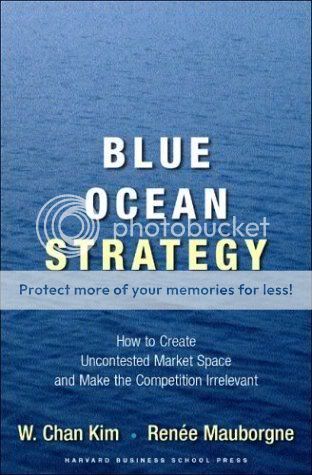
Blue Ocean Strategy

The “ocean” refers to the market or industry. “Blue oceans” are untapped and uncontested markets, which provide little or no competition for anyone who would dive in, since the markets are not crowded. A “red ocean”, on the other hand, refers to a saturated market where there is fierce competition, already crowded with people (companies) providing the same type of services or producing the same kind of goods.

Their idea is to do something different from everyone else, producing something that no one has yet seen, thereby creating a “blue ocean”. An essential concept is that the innovation (in product, service, or delivery) must raise and create value for the market, while simultaneously reducing or eliminating features or services that are less valued by the current or future market.

More info: http://www.blueoceanstrategy.com/downloads/bos_web.pdf

Work is love

Work is Love made visible.
And if you can’t work with love but only with distaste,
It is better that you should leave your work
and sit at the gate of the temple and
take alms of the people who work with joy.

Kahlil Gibran

The Hidden Dangers of Cell Phone Radiation

The Hidden Dangers of Cell Phone Radiation

By Sue Kovach

Every day, we’re swimming in a sea of electromagnetic radiation (EMR) produced by electrical appliances, power lines, wiring in buildings, and a slew of other technologies that are part of modern life. From the dishwasher and microwave oven in the kitchen and the clock radio next to your bed, to the cellular phone you hold to your ear—sometimes for hours each day—exposure to EMR is growing and becoming a serious health threat.

Read the entire article

Electromagnetic Radiation:
Intervention Recommendations from the Safe Wireless Initiative

To minimize dangerous electromagnetic radiation from your personal environment:
Keep your cell phone at least 6-7 inches away from the body while it is on. Continue reading “The Hidden Dangers of Cell Phone Radiation”

Singapore Government investments de-linked from CPF funds

IN ‘CPF finances: Clarity needed to clear the cloud of confusion’ (ST, Sept 20), Ms Chua Mui Hoong questioned whether the CPF provides a cheap source of funds for the Government’s investments. Subsequent Forum letters also raised the matter of how the return on CPF funds is calculated, and what constitutes a fair return.

The interest members receive for their CPF money should reflect what they could earn by investing in the financial markets, in investments which have comparable risk and duration. All CPF balances are guaranteed by the Government and hence free of risk. Hence the Special, Medisave and Retirement Account (SMRA) interest rates will now be pegged to long-term government-bond yields. Furthermore, the first $60,000 of each person’s CPF balances, to be held for the long term, will attract an extra 1 percentage point in interest. This means that they will always earn at least 3.5 per cent interest.

No commercial bank or fund manager offers more generous terms on such investments. Members seeking higher returns can take out their funds to invest through the CPF Investment Scheme (CPFIS). However, 83 per cent of CPF members who invested their OA savings in the CPFIS from 2002 to 2006 realised less than 2.5 per cent returns – the base rate of the OA. Half of all members who invested experienced negative returns, losing some part of their capital sum.

The CPF Board invests members’ savings in special securities issued by the Government, which pay the CPF Board the same interest rates that its members receive. The Government pools the proceeds from issuing these securities with the rest of its funds, and invests them professionally for long-term returns. This is completely de-linked from the CPF Board and CPF members. Were this not so, CPF members would be exposed to the investment risks and could not receive guaranteed minimum interest rates.

Up to now, both GIC and Temasek Holdings have earned returns that exceeded CPF interest rates, on average over the years. But this does not mean that the Government is making use of the CPF as a ‘cheap source of funds’, or earning a ‘spread at people’s expense’.

First, the Government does not need more funds to invest. Even if it did, it could raise funds more cheaply by issuing treasury bills and government securities, instead of using CPF funds.

Second, Temasek and GIC achieve higher returns on average only by taking on more investment risks. Hence these returns are volatile – they can be low or even negative in some years. Furthermore, we cannot assume that GIC and Temasek will do as well in future. The past two decades have been an exceptional period for global financial markets. Looking ahead, we cannot rule out protracted market downturns, lasting several years. Most CPF members have small balances and will not welcome these risks. Neither will older members waiting to withdraw their retirement funds.

Third, Singaporeans benefit when GIC and Temasek investments do well. Every year, the Government draws part of these investment returns to fund the annual Budget. The revenue is spent on worthwhile investments and social needs, including subsidies for housing, education and health care. And from time to time, the Government distributes accumulated budget surpluses to citizens through CPF top-ups and other schemes.

The Government does not rule out the possibility of introducing private pension plans for those with balances above $60,000 and a higher capacity to take risk. However, it would be unwise for members with low balances to take excessive risks on their basic retirement savings.

The current arrangement thus enables all CPF members to earn fair and risk-free returns on their retirement savings, while benefiting from the good performance of GIC and Temasek through the annual Budget. This is the right way to help Singaporeans save for their old age, and enjoy peace of mind in their golden years.

Jacqueline Poh (Ms)
Director (Special Duties)
Ministry of Finance

Shambhala Meditation Center of Chicago

Fix your posture
Align it with heaven and earth
You are a lightning rod between them
Relax everything
Let your past dissolve into the earth
Let your future dissolve into space
Let the present moment dissolve into your breath

And then,
Forget everything you just did
Stare directly into space and relax your mind
Whatever happens don’t be concerned
The absence of deliberate action is the real message
We make too big a deal of practice

Relax
If something occurs, fine
If nothing occurs, fine
The moment is empty

– Vajra Regent , Shambhala Meditation Center of Chicago