
You are not here to change the world. The world is here to change you.
Shantideva
In the beginner's mind there are many possibilities, in the expert's mind there are few.
You are not here to change the world. The world is here to change you.
Shantideva

Namaste with Nicolas Tang @ Bliss, Sat 2 Sep 2006
0000-0200 hrs
1. Tillman Uhrmacher – Om Nama Shiva (Tillmans Midnight Extended Club Mix)
2. Lost Witness feat. Tiff Lacey – Home (Mike Shiver Catching Sun Remix)
3. Underwater – Waterplanet (Dreas Remix)
4. Alex Morph presents Everest feat Tashita – Oree (Instrumental Remix)
5. Andain – Beautiful Things (Photon Project Mix)
6. Armin van Buuren – Burned with Desire (Rising Star Remix)
7. Aalto – Taurine (Super 8 Remix)
8. Aalto – Rush (Super 8 vs Orkidea Remix)
9. Oceanlab – Beautiful Together (Signum Remix)
10. Rusch & Murray – Epic (Above & Beyond)
11. Polner & Sender – Energy Sublimation
12. White Room – White Room
13. Pulser – Point of Impact (Mike Koglin Remix)
14. Darren Tate & Jono Grant – Sequential
15. Kamil Polner – Ocean Waterfall
16. Agnelli & Nelson – Holding on to Nothing (Paul van Dyk Edit)
17. Armin van Buuren pres Alibi – Eternity (Original IC Mix)
18. Simon Patterson – F-16
19. Matt Hardwick vs Smith & Pledger – Connected
20. Motorcycle – As The Rush Comes (Armin van Buuren’s Universal Religion Mix)
Many thanks to Garry and Fernando at Bliss and all who turned up!

Jeff, Stephen and me at Jeff’s Farewell Party at Tribeca last night.

“Kamala alone had been dear to him, precious to him – but was she still? Did he still need her or she him? Were they not playing a game without end? Was it necessary to live for that? No, it was not necessary! This game was called samsara, a game for children, a game that might be lovely to play once, twice, tenfold – but again and again?”
Siddharta by Herman Hesse
Love does not consist in gazing at each other but in looking outward together in the same direction.
Antoine de Saint-Exupery
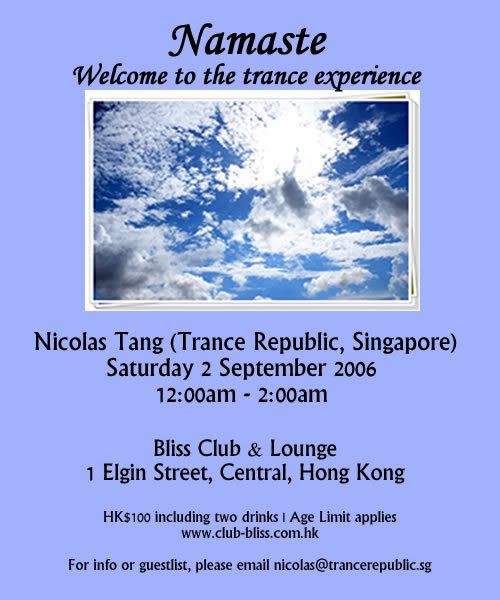
Namasté is the first in a series of trance events in Hong Kong which seeks to promote trance music to international standards. Namasté or Namaskar (?????? in Hindi, from Sanskrit namah te ) is a South Asian greeting originating in India, which is used when both hello and goodbye would be used in English. This also recognizes the equality of all, and pays honor to the sacredness and interconnection of all, as well as to the source of that interconnection.
DJ Bio
Born in Singapore in 1976, Nicolas Tang discovered trance music in the UK in 1997. Upon his return to Singapore in 2000, he discovered it did not have much of a trance scene. His interest in trance led him to set up Trance Republic ( http://www.trancerepublic.sg) with fellow DJs Jas K and Brandon Wong. Since then, he has played at various Singapore clubs including Phuture, Milkbar, Fuse, Liquid Room and Velvet Underground and is known by his fans for spinning uplifting and vocal trance anthems.
Through the organisation of trance events and by working closely with superclubs towards promoting trance, Trance Republic gradually elevated the trance scene in Singapore to what it is today. This summer, Trance Republic released REPUBLIKA II, its second compilation featuring music from Armin van Buuren, Gabriel & Dresden, Andy Moor, Above & Beyond and more.
Nicolas emigrated to Hong Kong in 2006 and plans to contribute to the scene here with the launch of regular trance events. “After checking out clubs in Hong Kong, I realised that there is still room for trance music,” says Nicolas. “I would like to see Hong Kong’s trance scene improve and I believe that this city has great potential”.
Bliss admission on 2 September for non-members (incl 2 drinks): HK$100

Photo: fotogrefer
A customer is the most important visitor on our premises. He is not dependent on us. We are dependent on him.
He is not an interruption of our work. He is the purpose of it.
He is not an outsider to our business. He is part of it.
We are not doing him a favour by serving him. He is doing us a favour by giving us the opportunity to do so.
Mahatma Gandhi
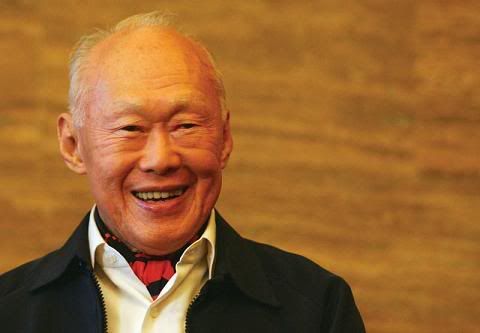
Everyone knows about Minister Mentor Lee Kuan Yew or MM as Singaporeans fondly call him. An icon of Singapore, there is a lot of literature about MM’s life, ?his magnificent achievements and his views. Frankly, there is little about MM that we do not know or which can still be written about. This interview focuses on MM – the lawyer, his values and principles, his frank views about the legal profession, leadership, and communication. Of course, no story about MM is complete without mention of his two favourite topics – Singapore and China.
‘I do what is right and I do it to the best of my capability. If that is inadequate, that’s all I can do,’ says MM of his guiding principle. What is right, to him, is based on integrity and realism.
In the 1950s, MM had been unsure of Singapore’s future. ‘I did not know how the world economy will perform or the dominance of technology then. My colleagues and I did the best we could under the circumstances then.’
When asked whether he liked the state of Singapore today, he replied that ‘like’ was a difficult and inadequate word to describe modern Singapore. ‘We have become a valuable red dot. We are highly organised, at our optimum and well connected. Our forte came from adopting the English language.’
A keen spectator of international developments, MM gave insights on the new super power in Asia – China. When he visited Shanghai in 1976, it was dark, overcrowded and full of pre-world and dilapidated buildings. MM predicts that Shanghai, with a growing population of about 1,300 million, will take over Hong Kong and become ‘the major centre of the Far East’ in the future. Before that, they need to go through the transition of mastering the English language and developing the rule of law, he says.
MM has always been very interested in the growth and workings of China. A friend of China, it is not surprising that the world leader who has left the greatest impact on him is the late Chinese communist party chairman, Deng Xiaopeng. ‘He is an outstanding leader. He has a decisive quality and a sense of realism. He goes to the heart of the matter. When we meet, he would speak in Szechuan Mandarin and I would communicate in English. He is the man who saved China. His visit to third world countries Bangkok, Kuala Lumpur and Singapore must have made him realise that China was on the wrong track. In December 1978, he opened up China.’
According to MM, Singapore will serve as the platform for Shanghainese businesses to operate and go regional. He acknowledges that the Singaporean Chinese are very different from the mainland Chinese. ‘Although we may speak the same language, we are very different from the mainland Chinese. Our beliefs and value systems are different. Our culture is different and will continue to be. Nothing is static.’
Singaporeans have to brace themselves for change, he cautioned. ‘We must never forget that we are living in a fast changing world. We have to continuously keep changing. That’s the only way to remain relevant. The strategy for Singapore’s continuous successful future is to move ahead and pre-position ourselves. Think beyond tomorrow,’ he reiterated.
Emphasising the importance of intellectual quotient (‘IQ’), MM acknowledges that the current method of selecting Singaporeans, be it into the Public Service Commission or into the NUS law faculty, is not perfect. ‘Certificates, character references, psychometric tests and National Service records are useful aids but insufficient to pick the best man or woman.’
Do leaders need emotional intelligence? ‘A person with high IQ but no EQ is at a great disadvantage. EQ is essential.’ He illustrates this by referring to the Japanese. ‘Their body language and physical movements help them to communicate beyond words with the other person. Our judges in the courts, for example, may not be able to make good judgments if they do not feel for the people who appear before them.’
Good communication and connecting with people are qualities important to MM. To him, a good leader is a person who is able to connect with others. ‘When this happens, the people believe, have confidence in him and follow. He must lead by example and not by force.’
With many lawyers who are Members of Parliament (‘MP’s), can one naturally conclude that they make better politicians? MM disagrees. ‘It is true that lawyers, the litigation ones, communicate effectively in English. However, this does not make them better politicians.’ He explains that after the General Elections held in 2001, five new MPs, of which three were doctors, became Ministers. It was the doctor who was the better communicator, pointed out MM. A good politician has to speak the people’s language, connect with them and then communicate it in Parliament.
He traces the beginnings of politicians being lawyers to the old English political system. British MPs were poorly paid and needed a profession to supplement their incomes. They turned to law.
About 47 years have passed since MM practised law. His mother told him that he must have a profession, unlike his father who was a rich man’s son and a storekeeper. MM had three choices then – law, medicine or dentistry. All three would have helped him to be self-employed and not work for the British. He ?chose law.
In 1946, he boarded the Britannic for England. He spent the first year of his legal education in the London School of Economics. Not liking the life in hectic London, he moved to the Cambridge town and finished his legal education in its renowned university. In law school, he preferred the practical subjects of contract and property to Roman law or English legal system. His Cambridge education was not just about learning the law. It shaped his life as a future politician.

Back in Singapore, he practised litigation in the areas of contract, criminal and arbitration in Laycock & Ong. He was called to the Malayan bar and practised law in the then Malayan states as well. He did not enjoy his nine years of law practice. ‘I was selling my skills for a living. Whether my client was in the right or wrong did not matter. I did not think highly of the adversarial system.’
‘If I had remained a lawyer, it would have been a meaningless existence. I have been a participant and as Prime Minister, ?I studied the system. I found it an unfulfilling profession,’ he stated vehemently.
One of the stakeholders of the early legal system was the jury. During the Select Committee hearing for the abolition of the jury, MM questioned famous criminal lawyer David Marshall on how many of his clients in more than 100 of his murder cases were convicted. ‘He said only one. I then asked him whether any of his clients were guilty. He said that this had never occurred to him and that it was not for him to decide.’
MM, who was then Singapore’s Prime Minister, felt that his role was to ensure that the legal system brought justice, which should not be circumvented by skilful advocacy. Jury trial was abolished in Singapore in 1970.
When asked about his views on the legal profession as it stands today, he replied that the legal profession has come a long way since the 1960s. The NUS law faculty has developed to the extent that the top three to five per cent of its graduates are equal to their international counterparts.
MM appreciates the reasons why it is difficult for the Singapore legal profession to retain its lawyers. ‘Young lawyers often do not realise the competitive nature of the profession they are entering. This is not a problem peculiar to Singapore.’ On litigation lawyers, he commented that ‘litigation lawyers are a special group of lawyers. They are prepared to work very hard, do the getting up and articulate their points well in court. If you do not enjoy this, find it tiresome, then don’t do litigation. Be a solicitor or a company secretary,’ he advised.
‘Small law firms will always be there.’ Why? ‘There will always be those who do not prefer to work in larger firms.’ He felt that clients’ monies must always be safeguarded. ‘The Law Society has to implement the safeguards such as having two signatories, another person or the client.’
In his political career, MM acknowledges that his legal education helped him to understand the constitutional process and the legislative system. MM, his wife, and Eddie Barker were responsible for drafting the Singapore Constitution.
MM Lee’s foray into politics and his highly impressive political career are evidenced by the status enjoyed by Singapore in its short history of 41 years. The son that the legal profession lost was the gain for Singapore politics. His secondary school teacher’s prediction – ‘He is likely to attain a high position in life’ – has come true indeed.
Rajan Chettiar
Rajan Chettiar & Co
9 August 2006
Straits Times
(c) 2006 Singapore Press Holdings Limited
THE idea of selling his skills, and doing a job where it did not matter if a client was in the right or wrong, did not appeal to Mr Lee Kuan Yew as a young lawyer here. Recalling those times in the 1950s in an interview with the Singapore Law Gazette, Minister Mentor Lee also said he did not think highly of the adversarial system. But as the Law Society’s monthly publication noted in its latest edition: ‘The son that the legal profession lost was the gain for Singapore politics.’ Mr Lee said if he had remained a lawyer, ‘it would have been a meaningless existence. I have been a participant and as prime minister, I studied the system. I found it an unfulfilling profession’. He felt that his role when he was prime minister, was to ensure the legal system brought justice and that it should not be circumvented by skilful advocacy. One aspect of Singapore’s early legal system, trial by jury, was abolished in 1970 after Parliamentary Select Committee hearings. Mr Lee went into practice after returning from London and became, among other things, a legal adviser to several trade unions. He helped found the People’s Action Party in 1954, becoming its secretary-general and Singapore’s first prime minister in May 1959. In the interview at the Istana recently, Mr Lee was asked about the legal profession today. He said it has come a long way since the 1960s. The National University of Singapore’s law faculty has developed to an extent where its top 3 to 5 per cent of graduates are equal to their international counterparts. Mr Lee could also understand why it is difficult for the profession to retain lawyers, saying young lawyers do not realise its competitive nature. Without reference to any case, he also said clients’ monies must always be safeguarded. The Law Society has to implement safeguards ‘such as having two signatories, another person or the client’. But Mr Lee disagreed when asked if lawyers made better politicians. Although ‘it is true that lawyers, the litigation ones, communicate effectively in English’, this does not make them better politicians. He noted that after the 2001 General Election, five new MPs, of whom three were doctors, became ministers. Mr Lee did not name them, but the three doctors were Dr Ng Eng Hen, Dr Vivian Balakrishnan and Dr Balaji Sadasivan. It was the doctor who was the better communicator, he said, again without citing anyone in particular. Good communication and connecting with people are important qualities, and for him, a good leader is someone able to connect with others: ‘When this happens, the people believe, have confidence in him and follow. He must lead by example and not by force.’ Emotional intelligence is also as essential as intellectual quotient. ‘A person with a high IQ but no EQ is at a disadvantage,’ he said, citing the example of the Japanese. ‘Their body language and physical movements help them to communicate beyond words with the other person. ‘Our judges in the courts, for example, may not be able to make good judgments if they do not feel for the people who appear before them.’ As for whether he likes the state that Singapore is in today, he said modern Singapore had become a ‘valuable red dot’. ‘The strategy for Singapore’s continuous successful future is to move ahead and pre-position ourselves,’ he said. ‘Think beyond tomorrow.’
© 2006 Dow Jones Reuters Business Interactive LLC (trading as Factiva). All rights reserved.

Like the little stream
Making its way
Through the mossy crevices
I, too, quietly
Turn clear and transparent.

The birds have vanished into the sky,
and now the last cloud drains away.
We sit together, the mountain and me,
until only the mountain remains.

I need to put up with two or three caterpillars
if I want to get to know the butterflies.
Antoine de Saint-Exupery

If you let go of a little you have a little peace. If you let go of a lot you have a lot of peace. And if you let go completely, then you have complete peace.
I will be on leave in Singapore between 9 to 18 August 2006.
“As I ate my hot fudge sundae at the famous Hard Rock Cafe in London I noticed that amongst the rock memorabilia of the Beatles, Hendrix and Rolling Stones stood a life size photograph of a rather odd looking figure. But this fuzzy headed character dressed in bright orange/red is no rock star. He is Sri Sathya Sai Baba the guru of the blue chip multinational restaurant group and responsible for their corporate slogan ‘Love All. Serve All.’ Isaac Tigrett, the restaurant chain’s founder, believes that Sai Baba saved his life when his Porsche careered at 90 mph over a 300 ft drop. “Sai Baba appeared beside me in the car and put his arm around me. The car was totally destroyed but I got out without a bruise.” When Tigrett sold his share of the company for £16 million he gave all his money to Sai Baba’s cause.” – http://www.psychics.co.uk/saibaba/saibaba.html
“Wherefore, behold, I send unto you prophets, and wise men, and scribes: and some of them ye shall kill and crucify; and some of them shall ye scourge in your synagogues, and persecute them from city to city.”
Jesus in Matthew 23:34

“They say that once you are contented with what you are, you will have no growth, no progress. This is I think a superficial understanding. Real growth, true progress, begins when you get at the truth of what you are; when you can say “it is absolutely alright”, even though it may be very poor and miserable. So please observe your unsatisfactory situation more and more, and take better care of it as it is. Then you may see the door open to the next world. ”
Hogen-San, The Other Shore
By Ruth Gledhill
The Times
THE rivalries of Strictly Come Dancing look like a sedate waltz at a pensioners’ tea dance when set alongside a battle that is being played out around the ballrooms of Hong Kong.
There, a British champion and her partner are being sued for millions of pounds after he called one of their pupils a “lazy cow”.
The pupil is Mimi Monica Wong, a high-flying banker for HSBC Holdings Plc and a widow who looks a decade or more younger than her 61 years. The teachers are Gaynor Fairweather and her husband, Mirko Saccani, from Italy.
The saga in the Hong Kong High Court has lifted the lid on what goes on behind the glitter and glamour of one of the territory’s most popular pastimes. Continue reading “Dancing dispute is strictly courtroom”

‘Worst ever chaos’ at airport as 559 flights scrapped, delayed or diverted amid winds reaching 200km/h
More than 3,000 passengers were stranded by Typhoon Prapiroon at Chek Lap Kok last night in what an airline executive said could be the worst disruption since the airport opened in 1998.
Even though only the No 3 signal was hoisted, raging southeasterly winds stirred up by the storm churning 280km to the southwest, created conditions too hazardous for takeoff or landing.
By 11.30pm, about 70 per cent of 826 flights scheduled had been affected, with 158 delayed, 303 cancelled and 98 diverted to nearby cities. There were still more than 2,500 passengers stranded at the airport at this time. Forty more flights were expected to be affected. On July 7, 2001, 97 per cent of 551 scheduled flights were affected by Typhoon Utor, when the No8 signal was hoisted.
Dragonair, China Airlines and Eva Airways cancelled all afternoon flights to and from Hong Kong yesterday, while Cathay Pacific cancelled all flights till 9am today.
Hong Kong residents were offered HK$500 and sent home but international travellers had to scramble for scarce hotel rooms or spend the night at the airport.
“The airlines are so irresponsible. We are stranded here the whole day and they said they could not arrange a hotel for us,” said a woman giving her name as Emily, a Cathay Pacific passenger who should have been in Denpasar on the Indonesian holiday island of Bali by noon. Tired passengers resting on the floor could be seen in almost every corner of the airport, she said. “We are only offered water, snacks and blankets.”
Cathay’s general manager (corporate communications) Alan Wong Ka-lun said the number stranded was huge as most airlines were affected. “I think it is the first time that such a situation has emerged at Chek Lap Kok since its opening,” he said.

I want to make my life a ceremony around slowness.
Time and space.
Open space.
In the desert there is space.
Space is the twin sister of time.
If we have open space, then we have open time to breathe, to dream, to dare, to play, to move freely, so freely, in a world our minds have forgotten but our bodies remember.
Time and space.
This partnership is holy.
In these redrock canyons, time creates space;
An arch, an eye, this blue eye of sky.
We remember why we love the desrt;
It is our tactile response to light, silence, and stillness.
Hand on stone patience.
Hand on water music.
Hand raised to the wind is this the birthplace of inspiration?
Terry Tempest Williams
When I have a toothache, I discover that not having a toothache is a wonderful thing. That is peace. I had to have a toothache in order to be enlightened, to know that not having one is wonderful. My non-toothache is peace, is joy. But when I do not have a toothache, I do not seem to be happy. Therefore, I look deeply in the present moment and see that I have a non-toothache, that can make me very happy already.
If you are seeking, seek us with joy
For we live in the kingdom of joy.
Do not give your heart to anything else
But to the love of those who are clear joy.
Do not stray into the neighborhood of despair,
For there are hopes: they are real, they exist
Do not go in the direction of darkness I tell you: Suns exist.

Despite the city’s lifestyle and often choking pollution, its men live longer than those anywhere else on the planet and women’s life expectancy is second only to those in Japan, a Japanese government survey has found.
The average lifespan of a Hong Kong man is 79, ahead of Iceland and Switzerland with 78.9 and 78.6. Japanese men live for an average of 78.53 years.
For women, it is 84.7, just behind Japan, with 85.49, and ahead of Spain at 83.8.
Japanese women have been the longest-lived for 21 consecutive years, but the life expectancy of the country’s men dropped to fourth with 78.53 – the first time in 32 years they were out of the top three places.
The figures are based on the Japanese Health, Labour and Welfare Ministry’s “abridged life tables” which show how long a population at specified ages is expected to live, provided death-related conditions remain unchanged.
A Health Ministry official said the average lifespan of Japanese men and women had fallen slightly from a year ago because of a rise in flu-induced deaths.
“In my life, I’ve never wished that everything goes smoothly or satisfactorily, or that I may be free of any adversity. When encountering an adverse situation, I cope with it in this way: First I will tell myself, “If there’s a mountain in my way that can’t be removed, I will make a detour. If no detour can lead to my destination, I will change my way of thinking.” Once you change your thinking, the difficult situation you’re facing will no longer exist, which will naturally lead you to a new way out. Another way is to “face it, accept it, deal with it, and let it go.” There are problems that simply cannot be solved no matter how hard we try. In that case, we should accept the reality. In a way, accepting the reality amounts to dealing with it. And then you should let it go. Having let it go, you shouldn’t allow it to prey on your mind any longer and keep regretting and resenting. If you’re still caught up in regret and resentment, you’ll have twice as much bad luck because your confidence and courage have disappeared. During my most difficult time, it is as if I have been tied up all over with ropes, but my mind can still be doing taijiquan with freedom. As long as I don’t think I’m having bad luck, nothing can really annoy me.”
http://www.dharmadrum.org/news/NewsDetail.asp?PKey={F0AE31D2-C55D-450C-9BCE-5F1B875AAD5F}
Far Eastern Economic Review
March 2006

Last month, Jeremy Hurewitz met with the grand old man of Malaysian politics, Dr. Mahathir Mohamad. Wearing a pin proclaiming his desire for peace, Malaysia’s former prime minister spoke from his office in Putrajaya, the seat of the Malaysian government.
Jeremy Hurewitz: What are your thoughts on China’s rise? Do you see any threats from a powerful China?
Dr. Mahathir Mohamad: I think that China is bound to play a very important role in both East Asia and all the world. You cannot stop China. It is the sleeping lion who has now woken up. And his appetite is enormous. We have Chinese in this country [Malaysia], and we know that the Chinese are very dynamic, very intelligent, very skillful people, and when you consider that there are 1.3 billion Chinese in China, their ability to compete with the rest of the world is tremendous. Looking back, of course, China was industrialized long before Europe. They used to produce many goods, even if they didn’t then have the mass production techniques that they use today. They worked so fast that they could produce a lot of products which were used all over the world. They used to trade with us—textiles, stoneware, paper. Now they have adopted the techniques of the West: mass production, quality and innovation. That is the China of the future. And there is always the fear that this huge lion might gobble up the rest of the world. But we in Malaysia have had relations with China for over two thousand years. We have traded with China, but the Chinese have never colonized us. Even when they thought that we were not treating their people well we never had any of their warships come here in response. On the other hand, when the Europeans came here, specifically the Portuguese, some were arrested and detained by the Malacca government in 1509. Two years later a flotilla of ships came here and conquered Malacca. So the approach is quite different. We have been trading with China, India, the Arabs, the Persians and the Japanese for centuries. But the moment the Europeans came they think in terms of securing supply and monopolies. And basically they ended up conquering all their trading partners: Malaysia, Indonesia, Burma, Vietnam. They tried with China but it was too big. So we are familiar with the West.
JH: But is Malaysia threatened at all economically by China’s rise? For example, electronic components that were once sourced from Southeast Asia for assembly into consumer electronics in China, will likely—sooner or later—be made by China, and Malaysia will need to look elsewhere for its economic growth. How should Malaysia manage its relationship with China?
MM: A country’s development initially depends on their low-cost position: how willing the people are to accept low wages. As they develop their costs begin to rise as their people want to be more highly paid. Sometimes they become steadily less competitive. In the case of China this process will take a bit longer, much longer in fact. But even now we see on the eastern coast of China the costs and the wages of engineers are higher than Malaysia. They are actually beginning to invest in other countries. Maybe it’s in order to soft-pedal things, but if you look at the trade treaties between Malaysia and China, we are actually exporting electronic goods to China. Now supposing the Chinese become very rich, per capita income over a half century reaches that of the United States, they are going to be a very big market for us and we are sure to find something that they want which they cannot produce themselves. And certainly the number of tourists will increase tremendously. So there will be a change in terms of the character of our industry. But a rich China can be a useful market for us.

It is only with the heart that one can see rightly;
what is essential is invisible to the eye.
Antoine de Saint-Exupery

Hokusai says look carefully.
He says pay attention, notice.
He says keep looking, stay curious.
He says there is no end to seeing.
He says look forward to getting old.
He says keep changing, you just get more who you really are.
He says get stuck, accept it, repeat yourself as long as it’s interesting.
He says keep doing what you love.
He says keep praying.
He says everyone of us is a child, every one of us is ancient, every one of us has a body. He says every one of us is frightened.
He says everyone of us has to find a way to live with fear.
He says everything is alive- shells, buildings, people, fish, mountains, trees.
Wood is alive.
Water is alive.
Everything has its own life.
Everything lives inside us.
He says live with the world inside you.
He says it doesn’t matter if you draw, or write books.
It doesn’t matter if you saw wood, or catch fish.
It doesn’t matter if you sit at home and stare at the ants on the veranda or the shadows of the trees and the grasses in the garden.
It matters that you care.
It matters that you feel.
It matters that you notice.
It matters that life lives through you.
Contentment is life living through you.
Joy is life living through you.
Satisfaction and strength is life living through you.
Peace is life living through you.
He says don’t be afraid.
Don’t be afraid.
Look,feel, let life take you by the hand.
Let life live through you.
Roger Keyes, Providence Zen Centre

Once upon a time, a long time ago, and very far from here, a great Tibetan poet named Milarepa studied and meditated for decades. He traveled the countryside, teaching the practice of compassion and mercy to the villagers he met. He faced many hardships, difficulties, and sorrows, and transformed them into the path of his awakening.
Finally, it was time to return to the small hut he called home. He had carried its memory in his heart through all the years of his journey. Much to his surprise, upon entering he found it filled with enemies of every kind.
Terrifying, horrifying, monstrous demons that would make most people run.
But Milarepa was not most people.
Inhaling and exhaling slowly three times, he turned towards the demons, fully present and aware. He looked deeply into the eyes of each, bowing in respect, and said, “You are here in my home now. I honor you, and open myself to what you have to teach me.”
As soon as he uttered these words, all of the enemies save five disappeared. The ones that remained were grisly, raw, huge monsters.
Milarepa bowed once more and began to sing a song to them, a sweet melody resonant with caring for the ways these beasts had suffered, and curiosity about what they needed and how he could help them. As the last notes left his lips, four of the demons disappeared into thin air.
Now only one nasty creature was left, fangs dripping evil, nostrils flaming, opened jaws revealing a dark, foul black throat.
Milarepa stepped closer to this huge demon, breathed deeply into his own belly, and said with quiet compassion, “I must understand your pain and what it is you need in order to be healed.”
Then he put his head in the mouth of this enemy.
In that instant, the demon disappeared and Milarepa was home at last.

“You see, if you ask me to protect the reserves, then you’ve got to tell me what I’m supposed to protect.”
http://www.asiaweek.com/asiaweek/magazine/2000/0310/nat.singapore.ongiv.html

“Reality is an illusion – that’s the principle of ancient Buddhist thought,” Uma continues. “And the basic idea of being reborn is that you erase the memory. Everybody is interconnected, and you’re working out your karma with people – so you get erased, but all work left undone has to be completed.”