White Dragon King

Magical mystery man
He plays guru to celebrities and showbiz honchos, but who exactly is the Thai master they call White Dragon King?
By Foong Woei Wan
Straits Times, March 11, 2007
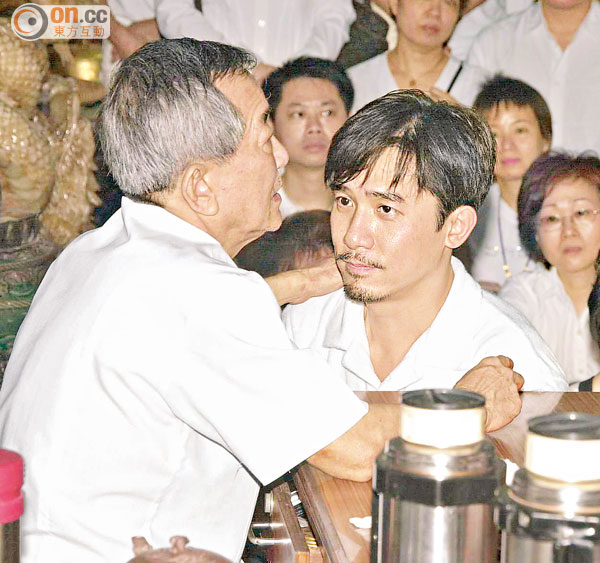
WHEN Martin Scorsese scored a Best Director Oscar last month for The Departed, an American remake of Infernal Affairs, he thanked Andrew Lau, the director of the Hong Kong film.

For days, Lau, his team and the Hong Kong movie industry basked in the reflected glory of the win.

Then Lau and his investor, Peter Lam, made their way to Pattaya, Thailand, to give thanks to their guru, a Chinese Thai man whom disciples call the White Dragon King.

The Hong Kong group – including friends like entertainers Richie Jen and Nat Chan – prayed at the self-styled prophet’s temple on March 3.

Like about 700 other devotees who thronged the temple that day, the celebrities wore white, walked around barefooted and waited in line to greet the guru. The next morning, the group and other disciples – by now a crowd of 1,000 – showed up at the temple again for an annual good luck ceremony.

‘I come here every year if I’m free,’ Lau told Apple Daily. ‘I can’t say what the White Dragon King’s instructions to me were, of course.’

The guru is much revered, and not just by Hong Kong celebrities, but much about his life is shrouded in mystery.

The White Dragon King began life as Chau Yun Nam and speaks Thai, Teochew and Mandarin. This much, at least, is known from Hong Kong reports.

But what he did in his early years, how he became a guru and even his age are the stuff of modern myth. Various versions of his story have been printed in Hong Kong and China.

Chau, 66 or 69, was most likely an electrical appliances or bicyle repairman, though some say he was a salesman.

More than 20 years ago, he either communicated with a white dragon deity or somehow began to believe that he was its reincarnation. In any case, he gave up his job and became a spiritual guide.

According to Hong Kong’s Next Magazine tabloid, he once turned away a group of tattooed men and tawdrily dressed women. Thereafter, to avoid offending him, his disciples decided to be decked in pristine white clothes whenever they called on him.

For about 18 years, the guru has played career consultant to Hong Kong celebrities. The region’s biggest names – Jackie Chan, Andy Lau and Tony Leung Chiu Wai – have gone on pilgrimages to meet the King. Others like Eric Tsang, Alan Tam, Rosamund Kwan, Shu Qi, Stephen Fung and Daniel Chan are known to throng the temple, too.

Tourists have followed in their footsteps, including some from Singapore.

All this has helped make the White Dragon King’s spacious temple an attraction like Bangkok’s Erawan Shrine, which houses the famous four-faced statue of Hindu deity Brahma.

LifeStyle zooms in on advice the guru has given and predictions he has made:

Before Leung became the toast of Chinese cinema, Chau reportedly foretold that he would be named Best Actor for the 1994 romance Chungking Express.

Leung won the Golden Horse and Hong Kong Film awards for the film in 1994 and 1995 respectively and has been a devout believer in Chau since, said the Sudden Weekly tabloid.

However, Leung has been visiting Chau without his girlfriend, actress Carina Lau. The guru has declined to meet her in recent years, saying they are not destined to know each other.

Media Asia chairman Lam, a long-time devotee of Chau, invited the guru to Hong Kong in 2002 to preside over a prayer ceremony for the filming of Infernal Affairs.

It was Chau’s first such visit to Hong Kong, and he caused a stir at the ceremony when he handed out fruits and hongbao of HK$100 each to the cast as well as reporters.

On Chau’s advice, Lam changed the crime drama’s four-word Chinese title, Wu Jian Xing Zhe (Continuous Traveller), to three characters: Wu Jian Dao (Continuous Hell).

The film made a killing at the box office, with HK$60 million in Hong Kong and S$1.2 million in Singapore.

So for the movie’s two sequels in 2003, Lam flew Chau to Hong Kong for the prayer ceremonies and premieres, too. For the record, both films were hits.

Hong Kongers had a scare when Chau reportedly predicted that ‘something bad’ would happen in the territory on the night of Feb 8, 2005.

He later told journalists that his advice was intended for only one of his Hong Kong believers, not everyone.


http://forums.hardwarezone.com.sg/showthread.php?t=1761716

Opening to Love

Every lesson that comes into your life

asks you to open your heart and mind in a new way.

Old defense mechanisms that are no longer needed for your survival

must be surrendered.

Inch by inch, the territory claimed by fear

must open to love’s embrace.

Paul Ferrini

Kindness


Photo: auws

Before you know what kindness really is
You must lose things,
Feel the future dissolve in a moment
Like salt in a weakened broth.
What you held in your hand,
What you counted and carefully saved,

All this must go so you know
How desolate the landscapes can be
Between the regions of kindness.
How you ride and ride
Thinking the bus will stop,
The passengers eating maize and chicken
Will stare out the window forever.

Before you learn the tender gravity of kindness,
You must travel where the Indian in a white poncho
Lies dead by the side of the road.
You must see how this could be you,
How he too was someone
Who journeyed through the night with plans
And the simple breath that kept him alive

Before you know kindness as the deepest thing inside,
You must know sorrow as the other deepest thing.
You must wake up with sorrow.
You must speak it till your voice
Catches the thread of all sorrows
And you see the size of the cloth.

Then it is only kindness that makes sense anymore,
Only kindness that ties your shoes
And sends you into the day to mail letters and purchase bread,
Only kindness that raises its head
From the crowd of the world to say
It is I you have been looking for,
And then goes with you everywhere
Like a shadow or a friend.

Naomi Shihab Nye

Ten Laws of the Modern World

1. Newton’s First Law of Motion
Bodies at rest, stay at rest. Bodies at motion, stay at motion.
(Substance of advice) x (velocity at which it is given) = impact of advice
What is the direction of your advice? Are you an Accelerator or Impactor?

2. Moore’s Law
The number of transistors on an integrated circuit for minimum component cost doubles every 24 months.

3. Metcalfe’s Law
The value of a telecommunications network is proportional to the square of the number of users of the system.

4. Gilder’s Law
The best business models waste the era’s cheapest resources in order to conserve the era’s most expensive resources.

5. Ogilvy’s Law
If each of us hires people who are smaller than we are, we shall become a company of dwarfs. But if each of us hires people who are bigger than we are, we shall become a company of giants.

6. Laffer Curve
Cut taxes at the margin, on income and capital, and you’ll get more tax revenue, not less.

7. Murphy’s Law
Things will go wrong in any given situation, if you give them a chance.

8. Wriston’s Law
Capital (meaning both money and ideas), when freed to travel at the speed of light, will go where it is wanted and stay where it is well-treated.

9. Ockham’s Razor
All things being equal, the simplest solution tends to be the best one (entia non sunt multiplicanda praeter necessitatem).

10. Ricardo’s Law
The natural price of labor is that price which is necessary to enable the laborers to subsist and to perpetuate their race, without either increase or diminution.

See also: http://www.forbes.com/columnists/columnists/2005/04/19/cz_rk_0419karlgaard.html

Tantra

You say yes. You say yes to everything. You need not fight, you need not even swim – you simply float with the current. The river is going by itself, on its own accord, everything reaches to the ultimate ocean. You simply don’t create any disturbance, you don’t push the river, you simply go with it.

That going with it, floating with it, relaxing with it, is tantra.

Singapore Girl

ST, 11 Feb
Original Singapore Girl defends the kebaya
SIA girls are globally recognised, says ex-stewardess who was model for uniform

By Nur Dianah Suhaimi

WHEN former Singapore Airlines stewardess See Biew Wah was sent to Paris in 1972, she had no idea that she would be shaping history.

Tasked to be the model for a new cabin crew uniform, Madam See became the mannequin on which French haute couturer Pierre Balmain perfected the cut and look of SIA’s famous sarong kebaya.

Now, 62 years old and a housewife, Madam See has joined the chorus of voices defending the SIA girl. She wrote in to The Sunday Times to say that the iconic uniform has always been the source of her strength and pride.

She was responding to last week’s column, Of Singapore Girls And White Men, which, among other things, made the point that the Singapore Girl deserves to be heard.

Since the national carrier announced last month that it would tender out its advertising account for the first time in 35 years, there has been public debate on whether the Singapore Girl should stay or go.

‘As one of the original Singapore Girls, I feel I have earned the right to speak up on behalf of her,’ said Madam See.

Twenty other readers wrote in sharing the same view.

Said Madam See: ‘The first time we wore the kebaya in Europe, several pedestrians walked into lamp posts because they were so engrossed. It’s a beautiful uniform which brings instant recognition.’

Because Europeans tend to be bigger than their Asian counterparts, SIA was asked to send a stewardess to Paris to model for Balmain. So for a week, Madam See posed for him.

Said Madam See: ‘He was extremely particular. If he didn’t like something, he’d just rip it off.’

Madam See has long given up her kebaya when she left SIA in 1980. But she claims she now has an ‘invisible uniform’ which has kept her strong and confident. ‘Once a Singapore Girl, always a Singapore Girl,’ she said.

Supernature

Straits Times. 11 Feb
By Nur Dianah Suhaimi

WHEN Ms C.F. Chen set up her organic food shop Supernature in a quiet corner of Wheelock Place 10 years ago, she had only five items sitting on the shelves and even fewer customers coming through the door.

When they did, they cringed at the prices and complained about holes in the apples and less-than-pristine vegetables.

Her friends thought she was crazy to have given up her $2,500-a-month job at the now defunct Telecommunication Authority of Singapore to sell ‘rabbit food’.

Today, the 37-year-old is having the last laugh.

Her two Orchard Boulevard shops are among more than 40 organic stores, cafes and warehouses in Singapore, all part of an industry estimated to be worth between $6 million and $10 million a year.

Organic food is produced without artificial pesticides or fertilisers. It is also free of additives and, in the case of organic meat, growth hormones.

Last week, Club 21 founder Christina Ong’s COMO Group bought over the two shops for an undisclosed sum, leaving Ms Chen in charge of the day-to-day operations.

Continue reading “Supernature”

Speculation

There are many ways in which speculation may be unintelligent. Of these the foremost are:

(1) speculating when you think you are investing;

(2) speculating seriously instead of as a pastime, when you lack proper knowledge and skill for it; and

(3) risking more money in speculation than you can afford to lose.

Benjamin Graham

Goo Goo Dolls

There was once a man and woman who had been married for more than 60 years.

They had shared everything. They had talked about everything. They had kept no secrets from each other except that the little old woman had a shoe box in the top of her closet that she had cautioned her husband never to open or ask her about.

For all of these years, he had never thought about the box, but one day the little old woman got very sick and the doctor said she would not recover.

In trying to sort out their affairs, the little old man took down the shoe box and took it to his wife’s bedside. She agreed that it was time that he should know what was in the box. When he opened it, he found two crocheted dolls and a stack of money totaling $25,000. He asked her about the contents.

“When we were to be married,” she said, “my grandmother told me the secret of a happy marriage was to never argue. She told me that if I ever got angry with you, I should just keep quiet and crochet a doll.”

The little old man was so moved; he had to fight back tears. Only two precious dolls were in the box. She had only been angry with him two times in all those years of living and loving. He almost burst with happiness.

“Honey,” he said, “that explains the dolls, but what about all of this money? Where did it come from?”

“Oh,” she said, “that’s the money I made from selling all the dolls.

The moment that breaks, it's gone

“In a different world we need to find a niche for ourselves, little corners where in spite of our small size we can perform a role which will be useful to the world. To do that, you will need people at the top, decision-makers who have got foresight, good minds, who are open to ideas, who can seize opportunities like we did… My job really was to find my successors. I found them, they are there; their job is to find their successors. So there must be this continuous renewal of talented, dedicated, honest, able people who will do things not for themselves but for their people and for their country. If they can do that, they will carry on for another one generation and so it goes on. The moment that breaks, it’s gone.”

Lee Kuan Yew, in an interview with CCTV, June 12, 2005

Peacekeeper

LGM-118A Peacekeeper missile system being tested at the Kwajalein Atoll in the Marshall Islands. The Peacekeeper was a land-based ICBM deployed by the United States starting in 1986. Each rocket could carry up to 10 re-entry vehicles, each with a nuclear warhead with the explosive power of up to 300 kilotons (twenty-five times the power of the bomb dropped on Hiroshima during World War II).

Life's Little Instruction Book

Have a firm handshake.

Look people in the eye.

Sing in the shower.

Own a great stereo system.

If in a fight, hit first and hit hard.

Keep secrets.

Never give up on anybody. Miracles happen everyday.

Always accept an outstretched hand.

Be brave. Even if you’re not, pretend to be. No one can tell the difference.

Whistle.

Avoid sarcastic remarks.

Choose your life’s mate carefully. From this one decision will come 90 percent of all your happiness or misery.

Make it a habit to do nice things for people who will never find out.

Lend only those books you never care to see again.

Never deprive someone of hope; it might be all that they have.

When playing games with children, let them win.

Be romantic.

Become the most positive and enthusiastic person you know.

Loosen up. Relax. Except for rare life-and-death matters.

Don’t allow the phone to interrupt important moments. It’s there for your convenience, not the caller’s.

Be a good loser.

Be a good winner.

Think twice before burdening a friend with a secret.

When someone hugs you, let them be the first to let go.

Be modest. A lot was accomplished before you were born.

Keep it simple.

Beware of the person who has nothing to lose.

Don’t burn bridges. You’ll be surprised how many times you have to cross the same river.

Live your life so that your epitaph could read, No Regrets.

Be bold and courageous. When you look back on life, you’ll regret the things you didn’t do more than the one’s you did.

Never waste an opportunity to tell someone you love them.

Remember no one makes it alone. Have a grateful heart and be quick to acknowledge those who helped you.

Take charge of your attitude. Don’t let someone else choose it for you.

Visit friends and relatives when they are in hospital, you need to only stay a few minutes.

Once in a while, take the scenic route.

Send a lot of Valentine cards. Sign them, ‘Someone who thinks you’re terrific.’

Answer the phone with enthusiasm and energy in your voice.

Keep a note pad and pencil on your bed-side table. Million-dollar ideas sometimes strike at 3 a.m.

Show respect for everyone who works for a living, regardless of how trivial their job.

Send your loved ones flowers. Think of a reason later.

Make someone’s day by paying the toll for the person in the car behind you.

Become someone’s hero.

Marry only for love.

Count your blessings.

Compliment the meal when you’re a guest in someone’s home.

Wave at the children on a school bus.

Remember that 80 per cent of the success in any job is based on your ability to deal with people.

Don’t expect life to be fair.

Insurance and Risk

The purpose of insurance is protection against financial disaster. In this regard, there are usually 3 areas where disaster can strike:

1. Loss of income. Not many people realize that their greatest financial asset is their ability to earn money. A disability, whether physiological (e.g. loss of one hand) or psychological (e.g. mental illness), results in an inability to perform productively. This means that you will either lose your high-paying job or become unable to operate your business effectively. Either way your income falls.

2. Loss of health. A major illness or accidental trauma can run up hundreds of thousands of dollars in medical bills, in addition to the loss of income during hospitalization.

3. Loss of life. This is actually a variation of a loss of income, since it’s not the life itself but the income associated with the lifespan that can be valued in monetary terms. However insurers distinguish between loss of life and loss of income since you can be alive and kicking but totally unable to earn your previous level of income.

Comparing your lifetime earnings and the typical rates quoted by an insurer, there is no excuse for not insuring your ability to work. A disability income policy will pay a percentage, usually 75% of your last drawn pay, should you become unable to work. If you suffer a pay cut it pays a percentage of the pay cut. A typical 25 year old fellow in Singapore earning say $30,000 annually would likely earn at least $900,000 over the next 30 years, excepting increments and bonuses. Yet the cost of providing 75% replacement income ($650,000) is $400 or less annually. It is the most cost-effective coverage you can buy – ‘leverage’ is over 1,500 times.

The average person gets sick 4-5 days a year, but that’s small things like a cough, cold or the flu. 1 in 3 men will suffer a heart attack, stroke or cancer before age 65. For women, it’s 1 in 5. There are other alarming medical statistics freely available that demonstrate that the likelihood of living out a full life without a major medical incident is rather low. The local Medishield and its variants offer extremely limited coverage – there are dollar caps on every item, plus a significant deductible. At a minimum, all locals should move to IncomeShield (best of the Shield variants), but it’s not enough.

A third-party hospital and surgical plan offers better coverage (no deductible, much higher dollar caps). Premiums are in the mid-hundreds to low-thousands per year, meaning you’ll likely spend $20,000 over a lifetime. But one medical claim alone can hit $20,000, and a major operation like an organ transplant can cost $200,000. So one claim, and you’ve recovered your premium costs. Of course, ideally you don’t want to have to claim at all! Insurance is one bet you always want to lose. Critical illness plans (which pay a lump sum on diagnosis) are a nice-to-have option, although their coverage overlaps with health and surgical plans (which work via reimbursement).

Loss of life is actually only an issue for those with dependents (young children, aged parents etc). For those without dependents, life insurance is actually a waste of money, because nobody suffers a financial loss if you die. All you need is enough coverage to pay for funeral expenses – and most locals are covered in this respect by the Dependants’ Protection Scheme (automatically paid from CPF unless you opt out). But for those with dependents, it is prudent to have sufficient coverage to cover the loss of income – disability coverage usually doesn’t pay much on death.

In financial terms, when facing a risk, one should, in order of preference:

1. Avoid it.
2. Minimise it.
3. Transfer it.
4. Absorb it.

As far as health/life is concerned, you can’t avoid getting sick. You can minimise the risk by maintaining a healthy lifestyle. You can transfer the risk of major bills to an insurer. You can absorb the risk of small bills from seeing your general practitioner.

Where income-earning ability is concerned, you can’t avoid getting injured or dying in an accident. You can minimise the risk of death or injury by choosing a less hazardous occupation. You can transfer the risk of consequent financial loss to an insurer. You can’t absorb the loss of income by saving enough money during good times.

Everyone but the extremely rich should have medical insurance to pay for bills and disability insurance to replace lost income. Only those with dependents should bother about life insurance.

Investment is a game of greed where you give up small known losses (in inflation and opportunity cost) in order to get large unknown gains. Insurance is a game of fear where you give up small known losses (in premiums) in order to avoid large unknown losses. Fear and greed are distinct; do not mix the two. Yet both are vital to any financial plan and must be adequately addressed.

Study: Milk dilutes benefits of tea

POSTED: 2239 GMT (0639 HKT), January 9, 2007

• Milk in tea eliminates protective effect against heart disease, study finds
• Researchers compared health effects on 16 healthy women
• Tea is second only to water in worldwide consumption

LONDON, England (Reuters) — Drinking tea can reduce the risk of heart disease and stroke but only if milk is not added to the brew, German scientists said Tuesday.

Research has shown that tea improves blood flow and the ability of the arteries to relax but researchers at the Charite Hospital at the University of Berlin, Germany, found milk eliminates the protective effect against cardiovascular disease.

“The beneficial effects of drinking black tea are completely prevented by the addition of milk, said Dr. Verena Stangl, a cardiologist at the hospital.

“If you want to drink tea to have the beneficial health effects you have to drink it without milk. That is clearly shown by our experiments,” she told Reuters.
Continue reading “Study: Milk dilutes benefits of tea”

The Centre of Love

When the human race learns to live as a family, then the world will finally attain the next stage of civilization and enlightenment. Families are meant to be centers of love, which radiate their love outward to other families. When people understand this purpose and can share the experience, then they can create joy and peace throughout society. When peace reigns, there will no longer be hatred or disturbances between people, and the human mind will automatically be led upward, toward the highest center of consciousness.

Swami Rama

GPS

Did you know that you can download free GPS maps – you will never get lost again and can visit all the hard to find Malaysian seafood places. If you have a car, you can even install a system that will read out directions for you through the car sound system. Your GPS can also be used when you visit other countries like Hong Kong, China, Japan and the U.S..

A good colour GPS Receiver from Garmin is about S$665 (US$365 from U.S., HK$3980 from HK).

Register and read the Wiki at this site for more information: http://www.malsingmaps.com

——————————————————-

Developed by the United States Department of Defence, GPS is officially named NAVSTAR GPS (Navigation Signal Timing and Ranging Global Positioning System). The satellite constellation is managed by the USAF 50th Space Wing. Although the cost of maintaining the system is approximately US$400 million per year, including the replacement of aging satellites, GPS is free for civilian use as a public good.
Continue reading “GPS”

faith, hope, love

If I speak in the tongues of men and angels,
but have not love,
I have become sounding brass or a tinkling symbol.

And if I have prophecy and know all mysteries and all knowledge,
and if I have all faith so as to remove mountains,
but have not love, I am nothing.

And if I dole out all my goods, and
if I deliver my body that I may boast
but have not love, nothing I am profited.

Love is long suffering,
love is kind,
it is not jealous,
love does not boast,
it is not inflated.

It is not discourteous,
it is not selfish,
it is not irritable,
it does not enumerate the evil.
It does not rejoice over the wrong, but rejoices in the truth

It covers all things,
it has faith for all things,
it hopes in all things,
it endures in all things.

Love never falls in ruins;
but whether prophecies, they will be abolished; or
tongues, they will cease; or
knowledge, it will be superseded.

For we know in part and we prophecy in part.

But when the perfect comes, the imperfect will be superseded.

When I was an infant,
I spoke as an infant,
I reckoned as an infant;

when I became [an adult],
I abolished the things of the infant.

For now we see through a mirror in an enigma, but then face to face. Now I know in part, but then I shall know as also I was fully known.

But now remains
faith, hope, love,

these three;

but the greatest of these is love.

1 Corinthians 13:1-13

SCMP: Clean up your act

Friday, December 15, 2006
Clean up your act
By Suzanne Harrison

LATE-NIGHT REVELLERS know about the steam room concept. Sweating out the alcohol makes you feel better, doesn’t it? Maybe so, but tailored spa treatments and/or at-home techniques could be ideal for those suffering New Year burnout – particularly if you combine it with healthy eating and exercise.

Lawrence Brown, from Body Conscious in Central, says now is the time to make the most of promotions for “all those New Year resolutions”. He says it’s a good kick-start in conjunction with a new exercise regimen and diet.

“It will help to get the elimination system moving, improving results of exercise and diet. It’s best to start with a few treatments for maximum benefit. The number will depend on the client and usually there’s following up with maintenance every three weeks to a month.”

Body Conscious offers lymphatic drainage which helps the release of toxins and diminishes the appearance of cellulite, he says. It can be followed by a detoxifying seaweed body wrap.

“This increases the effect, releasing toxins through the kidney and bladder, promoting tissue regeneration and balancing the circulation.”

Samantha Arnold, spa director of the Four Seasons Spa, says there is an increased demand for detoxifying or purifying treatments at the beginning of each calendar year and at the start of summer.

But while pampering yourself at a spa is one New Year’s resolution that’s not difficult to keep, can it really complement a plan to help rid your body of an overload of seasonal toxins?

Continue reading “SCMP: Clean up your act”

Swarming

Swarming is a military strategy in which a military force attacks an enemy from several different directions and then regroups. Important aspects of swarming are mobility, communication, unit autonomy and coordination/synchronization. The coordination and synchronization is of prime importance to protect against fraticide fire and achieve the overwhelming application of forces. The swarm use direct and indirect fire to achieve its goals.

SCMP: Survey confirms large numbers of HK people work overtime

A new survey shows many Hong Kong employees work a lot of overtime – and some do as much as six extra hours a day, the Apple Daily reported on Monday. The survey was conducted by Legislative Council member Mandy Tam Heung Man, who interviewed 377 full time employees.

Some 75 per cent of people surveyed said they needed to work overtime. Nearly 20 per cent said they worked overtime for five days or more.

But nine per cent of those surveyed said they had to work, at least, an six additional hours each day.

The survey also found 17.8 per cent worked overtime for five times or more each week. Most needed to work an extra two to three hours.

Over 90 per cent of respondents said the heavy workload affected their health.

“Working overtime has a negative impact on the productivity of employees,” Apple Daily reported citing the survey.

The survey found 46.9 per cent of respondents had taken sick leave in the past three months due to sickness caused by excessive work.

It found employees who needed to work overtime took, on average, more than 4.5 days sick leave annually.

Ms Tam said excessive overtime definitely affected the health of employees.

“It is also counterproductive and affects the daily operations of the organisation. Employees expressed their wish to be paid for their overtime,” she added.

Ms Tam urged the government to introduce legislation to monitor working hours.

Scorched Earth

A scorched earth policy is a military tactic which involves destroying anything that might be useful to the enemy while advancing through or withdrawing from an area. Apparently a translation of Chinese ?? (Jiao Tu), the term refers to the practice of burning crops to deny the enemy food sources, although it is by no means limited to food stocks, and can include shelter, transportation, communications and industrial resources, which are often of equal or greater military value in modern warfare, as modern armies generally carry their own food supplies. The practice may be carried out by an army in enemy territory, or by an army in its own home territory.

The scorched-earth defense is a form of risk arbitrage and anti-takeover strategy. When a target firm implements this provision, it will make an effort to make it unattractive to the hostile bidder. For example, a company may agree to liquidate or destroy all valuable assets, also called “crown jewels”, or schedule debt repayment to be due immediately following a hostile takeover. In some cases, a scorched-earth defense may develop into an extreme anti-takeover defense called a “suicide pill”.

Salubrion

Charles Saiki, a retired architectural draftsman and lifelong artist, faithfully meditated over the past thirty years in Hawaii. He first developed the idea of a compact meditation chair because he continuously needed to adjust his cushion, never achieving complete comfort or concentration. He spent three years refining its form and function before he shared the product with the world as the Salubrion Meditation Chair, becoming one of the most popular meditation stools in the U.S..

www.salubrion.com
Boing Boing

Dance Anthem

A dance anthem, floor filler or club anthem is a dance (or disco) track which receives almost timeless status, being played commonly many years after its release. Many older (pre-1990) tracks which are referred to as dance anthems are often only played at retro nights in clubs, or at themed parties. A common sub-category of dance anthems have sometimes been referred to as “tunes”, examples of such tracks include “For An Angel” by Paul van Dyk, “Energy 52” by Cafe Del Mar, “Carte Blanche” by Veracocha and “Born Slippy” by Underworld.

However, most commonly a dance anthem is a track which DJ’s still play in normal sets alongside the usual tracks. Some are played only towards the end of a set, almost as if a mini retro set was being played, but some are still used as if they were recently released dance music.

The term floor filler was coined to describe extraordinarily popular songs, due to the ability of certain tracks to bring people from the bar areas of nightclubs onto the dance floor. This is often due to the highly distinctive intros that some songs have but can also be due to the simple popularity and recognition of a song. DJs frequently reserve these tracks for critical times during their performances, to bring people to or keep people on the dance floor, thus ensuring a lively atmosphere.

The Alchemist

It was not easy to do; in earlier times, his heart had always been ready to tell its story, but lately that wasn’t true. There had been times when his heart spent hours telling of its sadness, and at other times it became so emotional over the desert sunrise that the boy had to hide his tears. His heart beat fastest when it spoke to the boy of treasure, and more slowly when the boy stared entranced at the endless horizons of the desert. But his heart was never quiet, even when the boy and the alchemist had fallen into silence.

“Why do we have to listen to our hearts?” the boy asked, when they had made camp that day.

“Because, wherever your heart is, that is where you’ll find your treasure.”

“But my heart is agitated,” the boy said. “It has its dreams, it gets emotional, and it’s become passionate over a woman of the desert. It asks things of me, and it keeps me from sleeping many nights, when I’m thinking about her.”

“Well that’s good. Your heart is alive. Keep listening to what it has to say.”

“My heart is a traitor,” the boy said to the alchemist, when they had paused to rest the horses. “It doesn’t want me to go on.”

“That makes sense,” the alchemist answered. “Naturally it’s afraid that in pursuing your dream, you might lose everything you’ve won.”

“Well then, why should I listen to my heart?”

“Because you will never again be able to keep it quiet. Even if you pretend not to have heard what it tells you, it will always be there inside you, repeating to you what you’re thinking about life and about the world.”

“You mean I should listen, even if it’s treasonous?”

“Treason is a blow that comes unexpectedly. If you know your heart well, it will never be able to do that to you. Because you’ll know its dreams and wishes, and will know how to deal with them.”

“You will never be able to escape from you heart. So it’s better to listen to what it has to say. That way, you’ll never have to fear an unanticipated blow.”

Water

Nothing in the world is as soft and yielding as water. Yet for dissolving the hard and inflexible, nothing can surpass it. The soft overcomes the hard; the gentle overcomes the rigid. Everyone knows this is true, but few can put it into practice. Therefore the Master remains serene in the midst of sorrow. Evil cannot enter his heart. Because he has given up helping, he is people’s greatest help. True words seem paradoxical.

Tao te Ching, Chapter 78