Top 50 Superclubs

List of Top 50 superclubs as voted by international DJs:

1 Space (Ibiza)
2 Fabric (London)
3 Pacha (Ibiza)
4 The End (London)
5 Warung (Itajai)
6 Panorama Bar (Berlin)
7 DC10 (Ibiza)
8 Amnesia (Ibiza)
9 Pawn Shop Lounge (Miami)
10 Zouk (Singapore)
11 Stereo (Montreal)
12 The Arches (Glasgow)
13 Turnmills (London)
14 Space (Miami)
15 Digital (Newcastle)
16 Ministry Of Sound (London)
17 Womb (Tokyo)
18 Guvernment (Toronto)
19 Cocoon (Frankfurt)
20 Pacha (New York)
21 D-Edge (Sao Paolo, Brazil)
22 Cavo Paradisco (Mykonos, Greece)
23 Sirena (Maresias, Brazil)
24 Crobar (Chicago)
25 Fuse (Brussels, Belgium)
26 Pacha (Buenos Aires)
27 Basics (Leeds)
28 Club Kristal (Bucharest)
29 Coco Rico (Riccione, Italy)
30 Cielo (New York)
31 Rex Club (Paris)
32 Robert Johnson (Frankfurt)
33 Yellow (Tokyo)
34 Tenax (Florence, Italy)
35 Weekend (Berlin)
36 Privilege (Ibiza)
37 The Cross (London)
38 Sankeys (Manchester)
39 Home (Sydney, Australia)
40 Pacha (Sao Paolo, Brazil)
41 The Key (London)
42 Babyface (Shanghai, China)
43 Honey Club (Brighton)
44 Se One (London)
45 Alter Ego (Verona, Italy)
46 Spundaue (Los Angeles)
47 Trilogy (Dubai)
48 Venue (Athens, Greece)
49 T Bar (London)
50 Ageha (Tokyo)

Battle of Clubs

ST March 11, 2007
Battle of clubs
Party Central is now firmly focused on the trinity of Zouk, Ministry of Sound and St James Power Station, each with its rabid fans

By Sandra Leong

IF YOU haven’t been out on the town for a couple of months, prepare yourself for a shock as you get set to spin around that disco ball.

In that short space of time, Singapore’s nightclub scene has exploded to centralise around three monster clubs, with news emerging yesterday that the dancefloor shake-up has claimed its first victim.

Smaller clubs are taking a thumping – literally. Thumper at Goodwood Park Hotel revealed that it has had to shut down.

The mid-sized nightclub was hit by falling takings as clubbers streamed to what has quickly become Party Central’s unholy trinity: iconic Zouk, massive Ministry of Sound (MoS) and the newcomer that drove the nail into Thumper’s coffin, St James Power Station.

One of Thumper’s owners, Mr David Chin, says the club’s downward spiral started last November when ‘all the big places started opening’, adding: ‘St James and all that… it took a big chunk out of us’.

But what do partygoers care: Many of them are no doubt pondering more pressing issues, like what to wear to St James’ official opening tomorrow night – a $600,000 bash, no less.

The megaclub opened in September with a soft launch, but immediately blasted the old scene to bits. It split Singapore revellers into three distinct tribes, based on what nightclub they prefer to go to.

New friendships were forged. Old ones failed. All hinges on what crowd you identify with. Are you a Smoover? Or a Dragonfly buzzer? Or does ol’ Velvet do it for you?

A whole new cultural touchpoint has sprung up, virtually overnight.

As one clubber, 26-year-old accounts manager Lisa Yeo, puts it: ‘Zouk people are the trendiest, MoS people are those who want to be trendy, and St James people are those who really don’t give a damn.’

WORLD-renowned Zouk at Jiak Kim Street; British legendary dance club MoS at Clarke Quay; and all-in-one entertainment complex St James Power Station at HarbourFront already account for up to 40 per cent of the nightlife scene’s estimated $250 million-a-year revenue, say industry players.

Although new, St James is the heavyweight of the three. Standing at over 70,000 sq ft with nine separate clubs, it is more than twice the size of Zouk and 11/2 times MoS – making the former coal-fired power station the biggest entertainment venue in Singapore.

Spruced up for a hefty $43 million, it has already garnered a reputation as a one-stop, hip spot offering everything from house to live music. Though it is targeted at PMEBs (professionals, managers, executives and businessmen), its crowd ranges from teens to 50somethings.

Tomorrow’s launch extravaganza is expected to be attended by more than 5,000 revellers. The $600,000 bill includes entertainment, food and drinks; and three cars, one to be given away every four months.

It will also be attended by Defence Minister Teo Chee Hean, which is probably the first time a club opening has received such a high-powered guest of honour.

St James chief executive officer Dennis Foo says Mr Teo was invited through the Workforce Development Agency, which has recognised the megaclub’s efforts to train its 350 staff in the hospitality trade.

Next up in size is the 40,000 sq ft MoS, which opened in December 2005 amid much hype. The franchise club has five themed rooms playing anything from retro to hip-hop and is touted as the most lavish MoS in the world.

Completing the trio, 16-year-old Zouk also upped the ante recently when it underwent a $5 million revamp in September 2005. At about 30,000 sq ft, it is still the smallest of the three, but what it lacks in size it makes up in reputation.

YET just two years ago, Thumper at Goodwood Park Hotel was the darling of Singapore’s nightlife scene, playing host to a bevy of Beautiful People, and even picking up the coveted Best Nightspot title awarded by the Singapore Tourism Board.

But today the mid-sized joint popular for its live band and sophisticated crowds is no more, no thanks to flagging crowds and a 70 per cent drop in business.

Over 1,000 nightspots – ranging from big-name establishments to neighbourhood pubs – now dot the island. But as far as some revellers are concerned – and as Thumper found to its cost – the trinity rules them all.

Indeed, Thumper’s Mr Chin owns another nightspot, Q Bar at The Old Parliament House, and he says its business dropped by about 50 per cent in January, though other factors such as heavy rain and the post-festive season also came into play.

Over at another mid-sized club, Attica, marketing manager Amanda Ng laments: ‘The growing number of such superclubs, mid-sized clubs and bars popping up does not justify the population of clubbers… ultimately, all in this industry will somehow or other be affected by this trend.’

St James’ Mr Foo, a nightclub scene veteran who also owns Devils Bar in Orchard Hotel, says: ‘Nowadays, customers look for the biggest, with the most, and having the best.’

Still, some would have thought the presence of incumbent biggies Zouk and MoS would have deterred St James from throwing its hat in the ring.

Indeed, when St James’ first outlet, mandopop jive Dragonfly, opened in September, it had a dry three weeks, recalls Mr Foo.

‘I was initially quite worried. But after the third week, the response grew and I can say the feeling was like coming out of a whirlwind into a clear blue sky.’

St James now makes close to $1 million every month, with every one of its outlets profitable, he reveals. That’s no small beer.

However, Mr Michel Lu, who ran the now-defunct Centro and now owns chill-out lounges like Suba and The Hacienda, notes: ‘I’m very confident that Dennis will do well… his focus is there because St James has many different offerings.’

WITH St James already proving a runaway success, neither Zouk nor MoS will admit to feeling any jitters, though.

Mr Clement Lee, executive director of MoS’ parent company LifeBrandz, says: ‘We have each targeted different markets. The proposition is different, the music is different.’

While St James may be big on live music, MoS, he says, is frequented by savvy dance music lovers who appreciate the ‘heritage’ of the brand, which has its roots in British youth culture.

From August to October last year, LifeBrandz’ lifestyle sector chalked up takings of $6.5 million, the majority of which came from MoS. The club sees about 20,000 to 30,000 partygoers a week.

Similarly, Zouk’s marketing manager, Ms Tracy Philips, counters that going by sales, the club had its ‘best year’ in its 16-year history. ‘The economy picked up, we had a lot of noteworthy events and we still enjoy a strong following.’

Though Zouk was initially hit by the entry of MoS, with business dropping by about 20 per cent, St James has not made much of a dent. Says Ms Philips: ‘In terms of size, we’re a mid-sized club. But in terms of status and quality, we are a super club. So I’d like to think we are somewhere in between in our own niche.’

Even Mr Foo stresses that St James was never designed to rival the other big boys. ‘From the start, we were clear about our different target audience – PMEBs. So St James merely filled what was a vacuum in the scene.’

St James’ chief operating officer, Mr Andrew Ing, also points out that about one-third of the club’s clientele comes from ‘latent’ demand – people who never used to club, but are now inspired to paint the town red.

So rather than compete, the relationship between the Big Three is complementary, with each generating interest for the other, says Ms Philips. ‘Every new outlet that opens now lends its success to the people who paved the way before.’

But some observers feel the ‘different strokes, different folks’ refrain is too convenient an explanation.

Says one industry player who declines to be named: ‘The Velvet (a club within Zouk) crowd has gone to Dragonfly (one of St James’ outlets), the Zouk people have gone to Power House. I would say Zouk has been widely affected.’

Adds Mr Lu: ‘The pie has grown a lot larger but, unfortunately, not large enough. Someone’s gonna hurt… Inevitably there will be some loss of crowd somewhere. Anyone who says his business is better than ever, it cannot be. How can it add up?’

Still, Mr Foo believes there is room for a fourth super club in Singapore.

He says: ‘It’s like saying, is there room for another six-star hotel. When St James first opened up, people said there wouldn’t be enough people. But the people will come.’

Dance Anthem

A dance anthem, floor filler or club anthem is a dance (or disco) track which receives almost timeless status, being played commonly many years after its release. Many older (pre-1990) tracks which are referred to as dance anthems are often only played at retro nights in clubs, or at themed parties. A common sub-category of dance anthems have sometimes been referred to as “tunes”, examples of such tracks include “For An Angel” by Paul van Dyk, “Energy 52” by Cafe Del Mar, “Carte Blanche” by Veracocha and “Born Slippy” by Underworld.

However, most commonly a dance anthem is a track which DJ’s still play in normal sets alongside the usual tracks. Some are played only towards the end of a set, almost as if a mini retro set was being played, but some are still used as if they were recently released dance music.

The term floor filler was coined to describe extraordinarily popular songs, due to the ability of certain tracks to bring people from the bar areas of nightclubs onto the dance floor. This is often due to the highly distinctive intros that some songs have but can also be due to the simple popularity and recognition of a song. DJs frequently reserve these tracks for critical times during their performances, to bring people to or keep people on the dance floor, thus ensuring a lively atmosphere.

Songs of the 80s

Each song reminds me of something.

ABBA – Super Trouper

A-Ha – Take On Me

Bangles – Eternal Flame

Berlin – Take My Breath Away

Breathe – Hands to Heaven

Chris Isaak – Wicked Games

Concrete Blonde – Joey

Crowded House – Weather With You

Duran Duran – Ordinary World

Fine Young Cannibals – She Drives Me Crazy

Freddie Aguilar – Anak

Johnny Hates Jazz – Shattered Dreams

Johnny Hates Jazz – Turn Back The Clock

Laura Branigan – Self Control

London Beat – I’ve Been Thinking About You

Martika – Love Thy Will Be Done

Queen – I Want To Break Free

Rita Coolidge – All Time High (from Octopussy)

Roxette – It Must Have Been Love

Sabrina – Boys

Sade – Smooth Operator

Suzanne Vega – Luka

Suzanne Vega – Tom’s Diner

Tears for Fears – Shout

Tears for Fears – Woman in Chains

The Cars – Drive

The Escape Club – I’ll Be There

The Police – Every Breath You Take

Tina Turner – We Don’t Need Another Hero

Toto – Africa

UB40 – Red Red Wine

U2 – Mysterious Ways

U2 – One

U2 – Pride (In the Name of Love)

Village People – YMCA

Wham – Careless Whisper

Yanni – Aria (From the British Airways Ad)

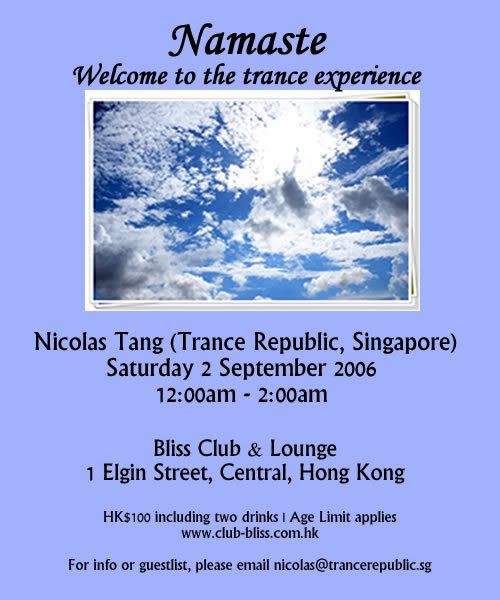
Tracklisting – Namaste with Nicolas Tang

Namaste with Nicolas Tang @ Bliss, Sat 2 Sep 2006
0000-0200 hrs

1. Tillman Uhrmacher – Om Nama Shiva (Tillmans Midnight Extended Club Mix)
2. Lost Witness feat. Tiff Lacey – Home (Mike Shiver Catching Sun Remix)
3. Underwater – Waterplanet (Dreas Remix)
4. Alex Morph presents Everest feat Tashita – Oree (Instrumental Remix)
5. Andain – Beautiful Things (Photon Project Mix)
6. Armin van Buuren – Burned with Desire (Rising Star Remix)
7. Aalto – Taurine (Super 8 Remix)
8. Aalto – Rush (Super 8 vs Orkidea Remix)
9. Oceanlab – Beautiful Together (Signum Remix)
10. Rusch & Murray – Epic (Above & Beyond)
11. Polner & Sender – Energy Sublimation
12. White Room – White Room
13. Pulser – Point of Impact (Mike Koglin Remix)
14. Darren Tate & Jono Grant – Sequential
15. Kamil Polner – Ocean Waterfall
16. Agnelli & Nelson – Holding on to Nothing (Paul van Dyk Edit)
17. Armin van Buuren pres Alibi – Eternity (Original IC Mix)
18. Simon Patterson – F-16
19. Matt Hardwick vs Smith & Pledger – Connected
20. Motorcycle – As The Rush Comes (Armin van Buuren’s Universal Religion Mix)

Many thanks to Garry and Fernando at Bliss and all who turned up!

Namaste with Nicolas Tang @ Bliss, 2 September 2006

Namasté is the first in a series of trance events in Hong Kong which seeks to promote trance music to international standards. Namasté or Namaskar (?????? in Hindi, from Sanskrit namah te ) is a South Asian greeting originating in India, which is used when both hello and goodbye would be used in English. This also recognizes the equality of all, and pays honor to the sacredness and interconnection of all, as well as to the source of that interconnection.

DJ Bio

Born in Singapore in 1976, Nicolas Tang discovered trance music in the UK in 1997. Upon his return to Singapore in 2000, he discovered it did not have much of a trance scene. His interest in trance led him to set up Trance Republic ( http://www.trancerepublic.sg) with fellow DJs Jas K and Brandon Wong. Since then, he has played at various Singapore clubs including Phuture, Milkbar, Fuse, Liquid Room and Velvet Underground and is known by his fans for spinning uplifting and vocal trance anthems.

Through the organisation of trance events and by working closely with superclubs towards promoting trance, Trance Republic gradually elevated the trance scene in Singapore to what it is today. This summer, Trance Republic released REPUBLIKA II, its second compilation featuring music from Armin van Buuren, Gabriel & Dresden, Andy Moor, Above & Beyond and more.

Nicolas emigrated to Hong Kong in 2006 and plans to contribute to the scene here with the launch of regular trance events. “After checking out clubs in Hong Kong, I realised that there is still room for trance music,” says Nicolas. “I would like to see Hong Kong’s trance scene improve and I believe that this city has great potential”.

Bliss admission on 2 September for non-members (incl 2 drinks): HK$100

Martin Audio M800

After I left Singapore, I sold most of my DJ equipment to Minzi and wasn’t sure whether to pursue DJing. When I was running Trance Republic between 2000 to 2005, it took up a lot of our time and I felt it wasn’t worth it at some stages.

Well after thinking about it for 6 months it is clear that Hong Kong’s dance scene is boring and they need another trance DJ. I have so many tunes to share with them.

I just placed an order for 2 Pioneer CDJ1000MK3s on Friday and bought an amplifier yesterday. I’m really happy with the amplifier, because I thought and considered what to buy. Most people use an amplifier like Pioneer, Denon, Yamaha etc. Something which they use for normal hi-fi use. I thought about it and as I was really happy with my Arcam Alpha 8 which I bought years ago and it was British made, I decided to buy an amplifier which is British made AND used in clubs. When I was in this club in Nottingham in 1999, the sound was really good and when I checked out the speakers, they were made by Martin.

Eventually I went to Apliu Street in Shamsuipo and bought a second hand one (new would cost HKD8,000) for HKD3,100. Carrying it home was no easy task, it was so heavy like a piece of iron and must have weighed at least 25kg. Then when I plugged it in, the first thing that happened was that a fan inside turned on, like a computer CPU fan.

What on earth is this, I thought, why does it need a fan? My question was answered when the next moment I dropped a vinyl. THE SOUND. The sound was so loud that it blew my socks off. I was using JBL Control speakers (as JBL is used in Fabric and Zouk, etc) and the sound projected to every corner of my apartment.

I broke into a cold sweat. What if my neighbours reported me to the police? Why did I buy such a powerful amplifier which is not meant for home use? But I consoled myself. Hang on, it’s the weekend and the sun is still up, of course people are allowed to blast music. In addition, it gives me exactly what I wanted – the British sound I am so familiar with from the British clubs.

Top 50 Clubs In the World

1

Name: Fabric
Location: London
Capacity: 1600
Website: www.fabriclondon.com

2

Name: The End
Location: London
Capacity: 1000
Website: www.endclub.com

3

Name: Turnmills
Location: London
Capacity: 1100
Website: www.turnmills.co.uk

4

Name: Pacha
Location: Ibiza
Capacity: 3000
Website: www.pacha.com

5

Name: Space
Location: Ibiza
Capacity: 5000
Website: www.space-ibiza.es

6

Name: Amnesia
Location: Ibiza
Capacity: 5000
Website: www.amnesia.es

7

Name: Womb
Location: Tokyo
Capacity: 1500
Website: www.womb.co.jp

8

Name: DC10
Location: Ibiza
Capacity: 1500
Website: www.circolocoibiza.com

9

Name: The Cross
Location: London
Capacity: 550
Website: www.the-cross.co.uk

10

Name: The Arches
Location: Glasgow
Capacity: 2000
Website: www.thearches.co.uk

11

Name: Zouk
Location: Singapore
Capacity: 3700
Website: www.zoukclub.com
Continue reading “Top 50 Clubs In the World” →

A very liquid investment

Finance Asia
Timothy Cuffe, 13 April 2006

Fancy owning your own bar?

My father was never one to dispense advice lightly, but on the odd occasion that he allowed himself the extravagance he would put forward a gem. Aside from his sage counsel on marriage, his other chestnut was: “Son, if you are ever going to invest your money in anything, make damn sure that it is something you know a lot about.” So here I am writing about investing in bars, a subject that I think I know an awful lot about. In fact, I would imagine my dad would be rather proud of all the comprehensive research I have done on the subject. With the high density of expat professionals in Asia, owning a bar sounds like the ideal investment for many potential entrepreneurs and bonus-laden investment bankers. Unfortunately owning a bar is not always about rooms filled with friendly conversation, pulling a few pints and people enjoying themselves. There is definitely more to the enterprise once you step behind the counter. “Owning your own food and beverage outlet can be hugely rewarding in many ways, but be aware that owning your own bar is a little like a relationship,” says Mark Leahy, a partner in the Singapore-based McCraic Holdings, owners of BQ, Molly Malone’s, Father Flanagan’s and Dharma Kebabs. “A successful business needs constant love, attention and care. It’s a long term commitment and if you neglect it, it can quickly lose its charm.” It is important to be realistic about the amount of work involved in running your own business, especially a bar, pub or restaurant. People think owning a bar is all about sipping cocktails, enjoying the craic with friends, but they often overlook the amount of hours that are involved in creating the idea for the bar, setting it up, stocking it and organizing and managing staff. “Running a bar isn’t easy – there are a lot of potential pitfalls to owning one,” says Lawrence Morgan, owner of Jem in Hong Kong’s illustrious Lan Kwai Fong district. One of the primary stumbling blocks in owning a bar is lax cost control, and that all begins with the property’s lease agreement. In Hong Kong, leases on commercial property are classically six-year agreements with a three-year rent review. Unfortunately, with soaring property values, bar proprietors who negotiated favourable leases three years ago are now seeing their landlords ask for another 40% or more when their review comes up. “Given the steep rise in property values and subsequent rental increases, a lot of bar owners are beginning to look at the numbers and realize that it just won’t work anymore,” says Morgan. Continue reading “A very liquid investment” →